Delhi’s water crisis is different from every other Indian metro’s — and in some ways, more frightening. While Bengaluru, Chennai, and Hyderabad are primarily battling groundwater depletion caused by local over-extraction, Delhi faces that same problem compounded by something no amount of local effort can fully control: dependence on water from other states, interstate political disputes, and a river so polluted it’s nearly unusable.
If you live in Delhi and you’ve experienced water cuts during summer, watched your colony’s tanker schedule become erratic, or noticed your borewell yield declining year after year, you’re experiencing the symptoms of a crisis that has been building for decades. Here’s what the data shows and what you can actually do about it.
The Numbers Behind Delhi’s Water Deficit
According to a 2024 study published in ScienceDirect, Delhi faced a water shortfall of around 70 million gallons per day (MGD) as of June 2024. The city’s water production dropped from 1,002 MGD to 932 MGD, primarily because of reduced supply from the Munak canal and the Wazirabad reservoir. The Delhi Jal Board (DJB) has been steadily increasing groundwater extraction from 86 MGD in 2020 to around 135 MGD in 2024 to compensate — but this is filling one hole by digging another.
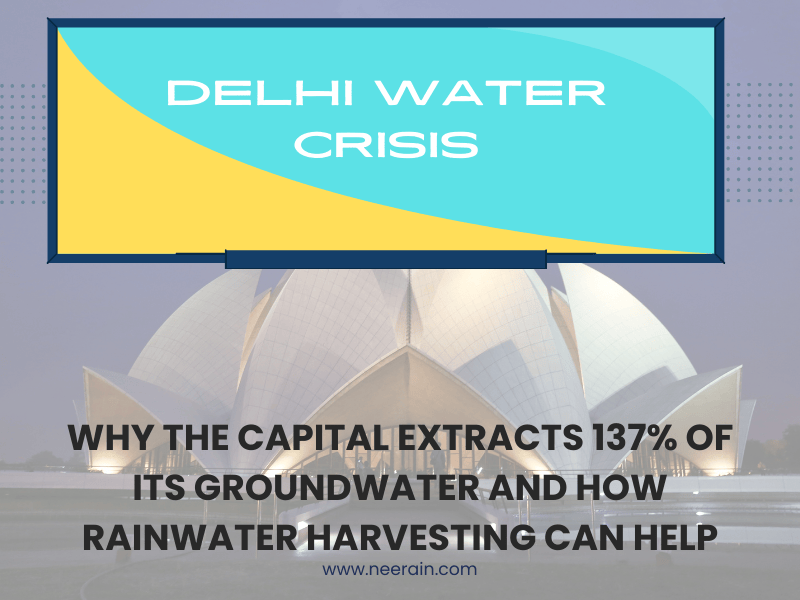
The groundwater extraction rate tells the real story. Delhi’s extraction exceeds 137% in some regions, with critical zones identified across New Delhi, North, and Northeast districts. The NCT Delhi withdraws and utilises 101.4% of the annual available groundwater across the territory. Groundwater levels are dropping by 2 to 4 metres every year. In the absence of external additions to Delhi’s water quota over recent years, this extraction rate has become the city’s default coping mechanism — and it’s clearly unsustainable.
The DJB has announced plans to add 1,034 new tubewells to extract an additional 23.45 MGD of groundwater. Experts from IWMI and other research bodies have warned that increasing extraction without matching it with recharge only accelerates the depletion cycle. It’s the same pattern we’ve seen in every water-stressed city: pump more today, face a bigger deficit tomorrow.
A River You Can’t Drink From and States That Won’t Share
Delhi’s water supply relies on external sources: the Yamuna River contributes about 40%, the Ganga River 25%, and Bhakra Storage 22%, with groundwater filling the rest. But the Yamuna — Delhi’s primary local source — is effectively unusable without extensive treatment. Ammonia levels regularly exceed 2.5 parts per million (the permissible limit is 0.5 ppm), and when ammonia spikes, production at the Wazirabad and Chandrawal water treatment plants drops by up to 50%.
The interstate dimension makes things worse. Much of Delhi’s water comes from Haryana and Himachal Pradesh via canals, and the allocation has become a recurring political battleground. During the brutal 2024 heatwave — when temperatures crossed 50°C in some areas, claiming more than 30 lives in a single month — the Supreme Court had to intervene, directing Himachal Pradesh to release surplus water.
For Delhi’s residents, this creates a fundamental vulnerability: your water supply can be disrupted by a political dispute between state governments, a pollution event upstream on the Yamuna, or a monsoon failure in a state hundreds of kilometres away. This is the strongest argument for rainwater harvesting in Delhi — not just as an environmental good, but as genuine water independence for your household.
The 2024 summer laid these vulnerabilities bare. Temperatures crossing 50°C in some pockets pushed water demand to record levels. Only three of Delhi’s nine water treatment plants were operating at full capacity. The Supreme Court’s intervention — directing Himachal Pradesh to release surplus water — was an emergency measure, not a sustainable solution. It highlighted a fundamental truth: a city of 20 million people cannot build long-term water security on the goodwill of other state governments.
For Delhi homeowners, this interstate dependence creates a practical problem that’s different from what residents of Bengaluru or Chennai face. In those cities, the water crisis is primarily about local groundwater depletion — serious, but at least within the city’s ability to address through local action. In Delhi, even if every household managed its groundwater perfectly, the city would still face supply disruptions from canal disputes, Yamuna pollution events, and monsoon failures in upstream states. This makes household-level rainwater harvesting not just an environmental good but a genuine resilience strategy.
Illegal Borewells and the Tanker Mafia
Delhi’s underground water economy is as chaotic as its surface one. The DJB identified over 19,000 illegal borewells in 2024, of which only about half had been sealed by year-end. Investigative reports have documented how private tanker operators have seized control of government-authorised borewells, diverted water from municipal pipes, and drilled illegal wells — selling what should be public water to desperate residents at premium prices.
Some Delhi families reported spending Rs 10,000 a month on private water tankers during the 2024 summer. During peak months, the DJB deployed 961 tankers — 811 hired and 150 departmental — across the city, up from 776 in February. Even that fleet couldn’t keep up with demand. The government set up a central war room headed by an IAS officer just to coordinate tanker logistics — a measure that speaks volumes about how severe the situation had become.
The contrast between Delhi’s official water infrastructure and its informal water economy is stark. While the DJB manages the formal supply chain — water treatment plants, pipelines, official tanker services — a parallel economy of private tanker operators, illegal borewell drillers, and water brokers has grown to fill the gap. This informal economy operates without quality controls, pricing regulation, or accountability. When you buy tanker water from an unauthorised source, you have no way of knowing whether the water has been treated, where it was extracted from, or whether it’s safe for drinking.
The groundwater depletion pattern across India is strikingly similar in every major city: over-extraction, falling water tables, deeper borewells, dry borewells, and rising tanker dependence. Delhi is simply further along this curve than many cities, which makes it both a warning and a laboratory for what works.
What Delhi Is Doing About Rainwater Harvesting
The DJB has made rainwater harvesting mandatory for all properties with an area of 100 square metres and above. The policy includes both incentives and penalties: compliant properties receive a 10% rebate on water bills, while non-compliant ones face a penalty equivalent to 50% of their total water bill. New water connections are only issued with a certificate confirming a functional RWH structure. The DJB also provides financial assistance of up to Rs 50,000 depending on plot size.
On paper, this is a strong framework. In practice, implementation has been uneven. As of 2021, only 1,869 private buildings had functional RWH systems, though 1,305 government buildings and 3,675 government schools had complied. Residents in dense areas like Krishna Nagar cite lack of space as a major barrier — but the DJB has been expanding its focus to public parks and open spaces, estimating that Delhi’s 16,000-plus parks spread across 8,000 hectares could harvest approximately 12,800 million litres of rainwater annually.
The DJB has also built 594 rainwater harvesting structures and installed 94 piezometers to monitor groundwater levels. The annual groundwater withdrawal in Delhi is about 479 MCM against only 281 MCM of natural recharge — a deficit of nearly 200 MCM that can only be bridged through systematic artificial recharge.
The policy architecture is actually quite comprehensive. RWH cells and 12 dedicated RWH centres have been set up across Delhi, with eight empanelled agencies providing technical expertise for installation. The DJB conducts regular field surveys to assess implementation and functional status. But the gap between policy and practice remains wide — partly due to space constraints in dense urban areas, partly due to lack of awareness, and partly due to the perception that rainwater harvesting is a “nice to have” rather than a necessity.
What Delhi Homeowners Should Know
Delhi receives about 600 mm of rainfall annually, concentrated mostly during the July-to-September monsoon. That’s less than Bengaluru or Chennai, but it’s still a significant volume of water when you calculate it across even a modest rooftop. A 100-square-metre roof receiving 600 mm of rain captures approximately 60,000 litres — enough to make a meaningful difference to your borewell recharge or to reduce your tanker dependence significantly.
The key challenge in Delhi is space. Many residential properties in older areas simply don’t have room for large storage tanks. This is where recharge-focused systems — which direct filtered rainwater into the ground rather than storing it in tanks — become particularly valuable. A properly designed recharge pit with a good filtration setup takes far less space than a storage tank and addresses the core problem: putting water back into the aquifer that your borewell draws from.
For Delhi properties specifically, the filtration system needs to handle the city’s particular pollution challenges. The initial rainwater that washes across a Delhi rooftop carries significant atmospheric pollutants — dust, particulate matter, vehicle emissions residue — that you absolutely don’t want entering your groundwater. A robust first flush diverter that cleanly separates the initial contaminated flow from the cleaner water that follows is not optional in Delhi; it’s essential. NeeRain’s systems are designed with exactly this kind of urban pollution challenge in mind, ensuring that what goes into your recharge pit is genuinely clean water, not a concentrated dose of rooftop contaminants.
The DJB’s Rs 50,000 financial assistance for installation, combined with the 10% water bill rebate for compliance, means the effective cost of a rainwater harvesting system in Delhi can be remarkably low. Factor in the penalty avoidance (50% of your water bill) and the tanker cost savings, and the financial case is overwhelming. You’re not just doing the environmentally responsible thing — you’re making one of the most straightforward financial investments available to a Delhi homeowner.
Even in space-constrained properties, there are options. Vertical recharge shafts that go deeper rather than wider can work in narrow plots. Borewell recharge through direct injection (with proper filtration) requires minimal surface footprint. The key is working with a provider who understands urban constraints and can design a system that fits your specific property layout — not a one-size-fits-all solution that assumes suburban lot sizes.
The groundwater story in Delhi has a geographic dimension that’s often overlooked. North and Northeast Delhi have deeper water tables and higher salinity in deeper aquifers, making drilling more expensive and the water quality worse. South Delhi, particularly areas like Greater Kailash, Defence Colony, and parts of R.K. Puram, have somewhat better groundwater conditions due to better soil recharge characteristics. But even the relatively better areas are over-exploited. This geographic variation means that the “right” water strategy in North Delhi (combining surface supply management with strategic harvesting) differs from South Delhi’s strategy, but both ultimately require reducing extraction and increasing recharge.
The Delhi government’s approach to the water crisis has evolved over time. In the 1990s and 2000s, the focus was on increasing supply — expanding treatment capacity, building new reservoirs, improving pipeline infrastructure. These were necessary but insufficient. By the 2010s, there was growing recognition that supply-side solutions alone couldn’t work, and the RWH mandate emerged as a demand-side response. But the implementation has been patchy — enforcement is weak, compliance is low, and most importantly, there’s no coordination between supply-side and demand-side strategies. Some neighbourhoods might be receiving good supply while having mandated RWH; others have poor supply and minimal RWH uptake.
The political economy of Delhi’s water situation is complicated by the fact that multiple agencies control water: the DJB operates the supply system, the Municipal Corporation manages some aspects, and state and national water boards operate the canals and barrage systems. This fragmentation means that no single entity has the authority or incentive to implement a comprehensive water security strategy. Individual homeowners can’t rely on the system to solve the problem — they have to solve it for themselves.
For Delhi residents in older colonies and older apartment buildings, retrofitting a functional RWH system can be technically challenging. These properties often have irregular roof designs, limited open space, and constrained foundations. However, Delhi-based providers have developed solutions specifically for these constraints — modular systems that can be installed on terraces without deep excavation, or compact systems that use existing well/sumps for recharge rather than requiring new construction. The key is finding a provider with experience in dense urban retrofit work rather than someone who defaults to standard designs.
The opportunity for Delhi is that the city has strong technical capacity — there are dozens of established RWH providers, engineering colleges actively researching urban water solutions, and an educated population generally receptive to environmental measures once the economic case is clear. What’s missing is the coordination and incentive structure that would unlock widespread adoption. If the city government were to provide subsidy for RWH installation (as some states do) or create meaningful penalties for non-compliance, the adoption rate could shift dramatically from the current 5-10% to 50%+ within a few years. The infrastructure and expertise exist — what’s lacking is the policy push.
The seasonal arithmetic is compelling even with Delhi’s relatively modest rainfall. If every property of 100 square metres and above in Delhi installed a functional rainwater harvesting system — which is already mandated by law — the collective recharge potential would be enormous. The DJB estimates that Delhi’s parks alone could harvest 12,800 million litres annually. Add residential and commercial rooftops, and you’re looking at a volume that could meaningfully close the 200 MCM annual recharge deficit. The infrastructure required to achieve this exists in concept; it just needs to be built, one property at a time.
The Bigger Picture: Water Independence in a Dependent City
Delhi’s unique vulnerability — its dependence on interstate water allocation — makes the case for household-level rainwater harvesting even stronger than in other metros. When the Munak canal supply drops, when ammonia spikes in the Yamuna, when Haryana and Delhi are locked in a political dispute about water allocation — none of that affects the rain that falls on your roof.
The Jal Shakti Abhiyan’s push for water conservation aligns perfectly with what Delhi needs at the household level. The national framework exists, the DJB subsidies exist, and the technology is proven. The gap is implementation — and that gap can only be filled one property at a time, by homeowners who decide that their family’s water security shouldn’t depend on political negotiations between state governments.
Delhi’s groundwater dropped 10 to 20 metres in the last decade. The extraction rate exceeds recharge by nearly 200 MCM per year. Every monsoon season that passes without your property contributing to recharge is a season that makes next summer’s water shortage a little worse — for you and for your entire neighbourhood. The technology to reverse this exists. The government support to fund it exists. The monsoon that provides the raw material comes every year without fail. The only missing piece is the decision to act — and every month of delay means higher tanker bills, deeper borewells, and a larger recharge deficit to overcome.