
Hyderabad’s water crisis has been building quietly — overshadowed by the more dramatic headlines from Bengaluru and Chennai. But the numbers coming out of the Telangana Groundwater Department are, in many ways, more alarming than either of those cities. If you live in Hyderabad and you’ve noticed your borewell needing to go deeper, your tanker bills climbing, or your neighbours drilling new borewells that fail within a season, this is why.
The Numbers That Should Worry Every Hyderabad Resident
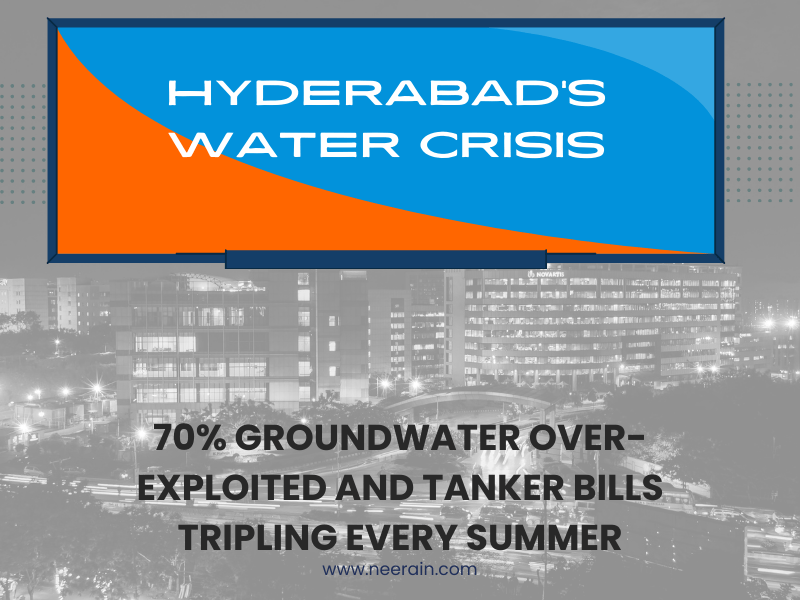
According to the Telangana Groundwater Department, 70% of Greater Hyderabad is extracting groundwater unsustainably. Of the city’s 16 mandals, 11 have drawn between 100% and 177% of their available groundwater. Let that number sink in — several parts of Hyderabad are extracting nearly twice as much groundwater as exists in the annual recharge cycle. That’s not a water budget that balances; it’s a deficit that compounds every year.
The city has lost 2.88 billion cubic metres of groundwater reserves, marking one of the steepest declines in the country. Despite receiving 15% excess rainfall in recent monsoons, groundwater levels continued falling by 1 to 3 metres across several areas. In places like Kukatpally, the water table has dropped to an alarming 25.9 metres below ground level. The reason is the same one devastating Bengaluru: massive construction and concretisation mean that even heavy monsoon rains simply cannot percolate into the ground.
Only 1% of Hyderabad now has shallow water levels (less than 5 metres below ground). About 35% of the city sits at 15 to 20 metres depth, and 10% has water tables deeper than 20 metres. For anyone relying on a borewell, these numbers translate directly into higher drilling costs, more frequent dry holes, and increasing dependence on tanker water. The connection between India’s deepening groundwater crisis and what’s happening in your neighbourhood is not abstract — it’s showing up in your water bill.
The geographic pattern of depletion tells an important story. The worst-affected areas — Ameerpet, Khairatabad, Amberpet, Asif Nagar, Saidabad, and the rapidly developing zones of Kondapur, Madhapur, and Gachibowli — are a mix of old city cores with aging infrastructure and new IT corridor developments with massive concretisation. In Rangareddy and Medchal Malkajgiri districts, areas like Balanagar, Bachupally, Serilingampally, Hayathnagar, and Saroornagar are all classified as over-exploited. These aren’t fringe areas — they’re the economic heart of Hyderabad.
The groundwater quality dimension adds urgency to the quantity crisis. As borewells go deeper, they increasingly tap into aquifer zones with higher mineral concentrations and potential contamination from industrial and sewage sources. Deeper water isn’t just more expensive to extract — it’s often of lower quality and may require additional treatment before it’s safe for domestic use. This creates a double cost burden: you’re paying more to drill deeper and then paying more to treat the water you find.
The Tanker Economy: Rs 10,000 a Month and Rising
Perhaps the most tangible measure of Hyderabad’s crisis is the tanker demand data. Water tanker bookings have tripled in just three summers — from about 50,000 to 75,000 bookings per month in early 2022 to over 2 lakh per month in 2025. In the first four months of 2025 alone, total bookings crossed 8 lakh, a 30% spike compared to the same period the previous year.
For families in areas like Kondapur, Madhapur, and Gachibowli — some of Hyderabad’s most developed IT corridor neighbourhoods — the weekly water spend has reached Rs 2,500 or more, with expectations that it could climb to Rs 3,000 during peak summer. That’s Rs 10,000 to Rs 12,000 per month on water alone. A 10 KL private tanker now costs Rs 1,500 to Rs 2,000, while a 25 KL tanker runs between Rs 3,500 and Rs 4,000.
This is money that disappears every month with nothing to show for it. Compare it to a one-time investment in a properly designed rainwater harvesting system — Rs 30,000 to Rs 80,000 depending on property size — that pays for itself within the first year of tanker savings and then continues delivering free water every monsoon for the life of the system.
The tanker economy creates its own distortions. As demand rises, tanker operators gain pricing power, and quality becomes harder to verify. Where does your tanker water come from? Is it from a regulated municipal source, or from a private borewell in a zone with known contamination? Most families have no way to know. The irony is that tanker water — the expensive fallback option when borewells fail — often comes from someone else’s borewell in a different part of the city, perpetuating the same extraction cycle that caused the shortage in the first place.
The Borewell Problem Nobody Talks About
Official records show Hyderabad has around 2.43 lakh borewells, but the actual number may be closer to 10 lakh. The gap between official and actual numbers tells you everything about the enforcement challenge. The WALTA Act 2002 restricts drilling borewells deeper than 400 feet, but many borewell rigs are going beyond 1,000 feet — and even those deep borewells are failing. A decade ago, a 600-foot borewell was considered adequate. Today, borewells drilled to 1,200 feet are coming up dry.
This is the classic borewell tragedy playing out across India: each individual drills deeper to chase a falling water table, which accelerates the decline for everyone. Without a corresponding recharge mechanism, every new borewell makes the problem worse. It’s a textbook tragedy of the commons — and the only way to break the cycle is to put water back into the ground at the same rate (or faster) than we’re taking it out.
The economics of borewell drilling in Hyderabad have become brutal. Drilling a new borewell to 800-1,000 feet costs Rs 1.5 to Rs 3 lakh, with no guarantee of finding water. Many homeowners report drilling two or three dry borewells before finding one that yields, turning what should be a one-time investment into a gamble that can cost Rs 5 to Rs 10 lakh with nothing to show for it. Compare that to a rainwater harvesting system at Rs 30,000 to Rs 80,000 that improves the yield of your existing borewell — the risk-adjusted economics overwhelmingly favour harvesting over drilling.
What Hyderabad’s Government Is Getting Right
The Hyderabad Metropolitan Water Supply and Sewerage Board (HMWSSB) has taken a carrot-and-stick approach that’s showing early results. The board has mandated that at least 17,000 large water consumers install or repair rainwater harvesting pits, with a financially meaningful penalty: non-compliant properties pay double charges for water tankers. Out of 45,000 houses surveyed by end of 2024, about 16,000 had already built the required structures.
The double-tanker-charge penalty is clever because it directly connects non-compliance with the cost the homeowner is already feeling. If you’re paying Rs 2,000 per tanker and non-compliance doubles that to Rs 4,000, the incentive to install a harvesting system becomes very real, very fast. Hyderabad has essentially made the economics of inaction more expensive than the economics of action — which is the most effective compliance mechanism any city has tried.
The adoption rate is encouraging: 16,000 out of 45,000 surveyed houses having built structures in the initial period suggests that financial incentives work better than appeals to environmental responsibility. When property owners can see a clear line between non-compliance and higher costs, behaviour changes. This is a model that other Indian cities would do well to study and replicate.
Rainwater harvesting has also been made mandatory for all new buildings with an area of 300 square metres or more, regardless of roof area. Combined with the state’s existing rules and the broader push under the Jal Shakti Abhiyan, Hyderabad’s regulatory framework is now among the strongest in India.
What Hyderabad Homeowners Should Do Now
If you’re a homeowner in Hyderabad, the situation is urgent but not hopeless. The monsoon will come, and every litre of rain that falls on your roof is either going into a storm drain (where it benefits nobody) or into a recharge pit beneath your property (where it directly improves your borewell yield and contributes to the local aquifer).
The economics are unambiguous. At current tanker prices, a family spending Rs 10,000 per month on water would recover the cost of a quality rainwater harvesting system in three to eight months. After that, the monsoon provides free recharge year after year. And unlike tanker water — which is extracted from someone else’s borewell or some distant source and trucked to your doorstep with all the quality uncertainties that entails — harvested rainwater that passes through a proper filtration system is cleaner and more consistent.
The critical requirement is getting the system right the first time. NeeRain’s rainwater harvesting systems are designed with Hyderabad’s specific challenges in mind — hard rock aquifers that need properly constructed recharge pits, monsoon intensity that demands robust first flush diversion, and long dry periods that make every captured litre count. A system designed for Hyderabad’s conditions will outperform a generic one by a significant margin.
Timing matters enormously. The ideal time to install a rainwater harvesting system is before the monsoon — giving you a full season of recharge from day one. Installing mid-monsoon means missing weeks of rainfall, and installing after the monsoon means waiting an entire year for the first recharge cycle. If you’re reading this between January and May, you’re in the optimal planning window. Get the system designed, installed, and tested before the first rains arrive, and you’ll see results in your borewell within the very first season.
The municipal water supply situation in Hyderabad adds another layer to the urgency. The HMWSSB supplies water through multiple sources: Himayatsagar (created in 1908), Osman Sagar (1908), Mir Alam Tank, Chandraprabha Lake, and Tolkakhanam Lake — plus supplies from the Godavari and Krishna river systems. In 2024, the city’s total surface water supply dropped by about 20% during the crucial summer months because monsoon recharge was poor. This meant that the 100 MCM daily supply from surface sources dropped to 80 MCM, forcing the municipality to declare water rationing and reduce supply days from daily to alternate days in many areas.
This surface water fragility is why groundwater has been so heavily tapped. For decades, groundwater was the “always available” option, the failsafe when surface sources fluctuated. But you can only use a failsafe so many times before it fails completely. Now Hyderabad is in the position of having squandered its groundwater reserves and still facing surface water constraints — a double crisis. This is the exact scenario that highlights why rainwater harvesting isn’t optional in Hyderabad, it’s foundational.
The institutional barriers to widespread RWH adoption are worth understanding. Many Hyderabad apartment societies have complex governance structures where multiple departments must approve any water infrastructure modification — the society managing committee, the HMWSSB’s own approval process, municipal building regulations, and sometimes environmental clearances for groundwater recharge. A homeowner or society that wants to install a system faces a labyrinth of approvals that can take 3-4 months. The HMWSSB, in recognition of this, has been working to streamline the process, but in practice, bureaucratic friction remains significant. This is why individual property owners often find it easier to just keep buying tanker water rather than navigating the system installation process.
The tanker mafia dimension deserves deeper exploration because it’s become a genuine political issue in Hyderabad. Tanker operators benefit from continued water scarcity — it drives up prices and demand. There’s been documented resistance from informal tanker operators to water conservation measures because these measures cut into their business. In some neighbourhoods, tanker operators have actively discouraged community RWH initiatives or spread misinformation about system effectiveness. This isn’t visible in the aggregate data, but it’s a real factor in why adoption lags behind even mandates. When an individual homeowner faces both technical complexity AND active discouragement from a vested interest, the friction to action increases dramatically.
For corporate institutions in Hyderabad — the IT companies, hospitals, and large commercial establishments — the calculus is entirely different. These entities operate at a much larger scale and see water as a significant operating cost. Microsoft’s Indian campus in Hyderabad has implemented an aggressive water conservation program including RWH, treated wastewater reuse, and closed-loop cooling systems. Similar programs at Infosys, TCS, and other major employers have driven adoption of advanced water technologies. These institutions see water security as a competitive advantage — a company that can operate reliably even during water rationing periods is more attractive to clients and employees.
The lesson for residential communities is that collectively, they have more bargaining power than they realize. A society that commits to comprehensive water management — RWH, grey water recycling, efficient fixtures, and maintenance protocols — can negotiate reduced HMWSSB charges (which have tiered pricing based on consumption) and sometimes even get municipal priority for supply during shortages. This kind of institutional innovation — where communities collectively invest in water infrastructure and management — is what ultimately transforms a city’s water security.
For apartment complexes and residential societies, the scale economics are even better. A 50-unit apartment building with a combined rooftop area of 5,000 square metres, receiving Hyderabad’s average 800 mm of annual rainfall, can capture approximately 40 lakh litres per year. Directed into properly constructed recharge pits connected to the building’s borewell zones, this volume can transform the water economics of the entire complex — reducing or eliminating tanker dependence and maintaining healthy borewell yields even through the hottest summers.
Don’t wait for the HMWSSB mandate to reach your property. The penalty for non-compliance is one cost. The real cost — the one that shows up in your monthly budget — is the tanker bill that keeps climbing every summer because nobody in your neighbourhood is putting water back into the ground. Be the household that breaks that cycle, and you’ll find your neighbours thanking you when their borewells start performing better too.