India’s groundwater is vanishing faster than we can pump it. The solution isn’t a government mega-project or an expensive contractor. It may be living two streets away.
Let’s think that it is peak summer and the third week of April in any of the hottest city in India. The overhead tank runs out before noon. You turn the borewell pump on and wait but there is some unusual silence. Your borewell has hit a dry patch again as it happens in every summer and this creates a panic .By evening, you have called multiple water tanker services, only one picks up and quotes the amount which is called ‘Season Rate’. This rate is as per the liking of suppliers pocket and damages your pocket the whole summer.
This is getting normal in every not an unusual story anymore. Across Indian cities Bangalore, Chennai, Hyderabad, Ahmedabad, Pune see variations of this scene play out in thousands of households every summer. The most important concern is that this is starting to become a new normal. It feels like a force of nature, an unstoppable urban reality. This concern should be addressed as the depleting levels will make the future worse and groundwater will be just in the history books.
The main question arises that does India have less rainfall? Here is the clear view of the rainfall, we enjoy enough rainfall but every monsoon, hundreds of thousands of litres of pure rainwater fall on your roof and wash straight into the storm drains. That same water, if redirected and filtered into your borewell, could recharge it enough to survive the following summer and again recharge it.
There is the part that surprises people even more: the person most qualified to make that connection, the one who already understands your home’s plumbing layout, pipe sizes, and water entry points, is not a distant sustainability consultant. It is your neighbourhood plumber.
*****
India’s Groundwater Is Running Out – Faster Than We Realise
India is the world’s largest extractor of groundwater, drawing more than 250 billion cubic metres each year, more than the United States and China combined. Abstracting this huge amount helps us to fulfill the daily needs but is leading to a ton of future problems. Our long life saving water is just being used without realising the future repercussions but we have no thought of any way to rejuvenate it and maintain it for our own betterment.
The Central Ground Water Board’s data makes for uncomfortable reading. Across India’s major urban districts, groundwater levels have been falling at an average of 0.3 to 1 metre per year. In critically over-exploited blocks – which now account for nearly 17% of all assessed blocks in the country – the decline is sharper still. Borewells that once hit water at 60 feet must now be drilled to 300 feet which results into the water of poorer quality, requiring expensive treatment and inviting health problems.
|
City |
Key Figure | What It Means |
|
Bangalore |
300 ft+ |
Average borewell depth today – up from 60 ft in the 1990s |
| Chennai | 50% |
Rise in groundwater after the city mandated rooftop harvesting |
|
Hyderabad |
70% |
Of groundwater zones classified as over-exploited or critical |
| Ahmedabad | ₹800–₹1,500 |
Per tanker delivery during peak summer – tripled in five years |
What makes the situation particularly frustrating is the paradox at its heart is that India is not a water-scarce country. The subcontinent receives approximately 4,000 billion cubic metres of rainfall annually – one of the most generously watered landmasses on Earth. But only about 8% of that rainfall is captured and used, among the lowest harvesting rates in the world. The rest flows off roofs, roads, and fields into rivers and out to sea. The amount of rainwater that is saved is
“India receives four lakh crore litres of rainfall every year. Only 8% is harvested – among the lowest rates anywhere in the world. The crisis is not scarcity. It is a waste.”
*****
Why Rainwater Harvesting Feels Complicated – And Why It Shouldn’t
Ask most Indian homeowners why they have not set up rainwater harvesting and you will hear a familiar set of responses. The mindset of the Indian house owner still lies in the good old science books where saving rainwater is a tough process and needs a lot of civil work. According to which the myths are that it is too expensive, you need an engineer and the municipality has to approve it. If someone has really tried to implement the system and faced issues using it makes people think that it is not for real life use and the concept was created for educational purposes. House owners are still stuck with the same good old mindset and not implementing any solution for saving rainwater thinking of the expense and maintenance of the same.
These objections are not irrational – they are a reflection of how rainwater harvesting was marketed and executed for the first two decades of its push in India. Large contractors designed complex civil systems involving soak pits, filter beds, gravel layers, perforated pipes buried deep in the ground, and dedicated recharge wells. These systems could cost anywhere from ₹1.5 lakh to ₹10 lakh. They required municipal approvals in some cities, civil excavation, and weeks of work.
All these problems are the reason why house owners lack awareness about saving rainwater and are also afraid to invest a hefty amount on something which people think is still a new concept in India. Saving rainwater has been a very old concept for India. The difference is that methodologies have changed. With changing time and requirements of people every individual should know what is the power of saving fresh water and money that is spent on water tankers.
The awareness gap compounds the cost problem
Beyond cost, there is a deeper issue: most homeowners do not know what borewell recharge actually means, or that their existing borewell can function as a natural storage vessel for filtered rainwater. They imagine elaborate underground cisterns and complex filtration stacks. The concept of running a simple filtered pipe from the rooftop drain down to the borewell casing – a connection that in modern plumber-friendly systems takes a few hours – has simply not entered the public imagination widely enough.
This is precisely where the story changes. Because the technology has caught up to the simplicity that was always theoretically possible.
*****
The Most Underestimated Expert in Water Conservation
India has approximately 2 million active plumbers working across cities, towns, and villages. These are the people who come when your pipe bursts at midnight, who reroute your bathroom during a renovation, who troubleshoot your borewell pump with a diagnostic instinct built over years of fieldwork. They know your home’s water map and know well each solution from fixing your tap to installing products like water tanks, appliances and what not.
Now consider what rainwater harvesting at the household level fundamentally requires: identifying where rainwater flows off the roof, intercepting that flow, passing it through a filter, and directing the filtered water into a storage or recharge point – which is often the borewell itself.
That is plumbing work. Straightforward plumbing work.
The only reason local plumbers have not been at the centre of the rainwater harvesting movement is because local contractors make it a very tedious process involving civil work and adding a huge cost to it. Any plumber near you has skill that can help you to uninstall a filter in just 2 hours which can save you a precious resource and recharge your borewell.
What local plumbers bring to the table
- Household knowledge – They already understand your plumbing layout like roof pipe routing, and borewell access point – the three things that matter most for a recharge installation.
- Community trust – Unlike a contractor arriving once and vanishing, your neighbourhood plumber is accountable. He returns for all your maintenance calls. He carries a reputation and trust in your neighbourhood.
- Speed and accessibility – A local plumber can assess and install in a single half-day visit with the right product in hand. No weeks-long project timeline. No extensive permits for a simple rooftop-to-borewell connection.
- Scalability – One trained plumber, working across his regular client base of 50–100 households, becomes a genuine node in a city’s water conservation infrastructure – without any central coordination.
- Affordable reach – The economics of local plumbing make the total installation cost accessible to the Indian middle class. No markup from a large contractor, no lengthy project management overhead.
*****
How Modern Plumber-Friendly Systems Have Changed the Game
The evolution of rainwater harvesting technology over the past decade has quietly made it one of those rare cases where a complex, traditionally expert-heavy intervention has been redesigned into something a skilled generalist can execute well. This has brought changes to traditional methods but the concept remains the same.
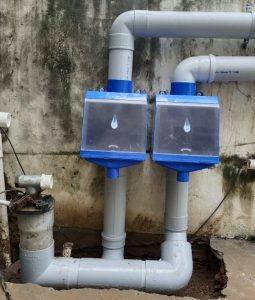
Modern rooftop rainwater harvesting filters work on a straightforward principle. When rain falls on the roof, the first flush – which carries dust, bird droppings, and debris – is automatically diverted away. Starting from the second rain rooftop water that follows passes through a multi-stage filtration mesh and flows down to the borewell or storage tank. No civil excavationNo dedicated recharge well. No gravel bed to build and maintain.
The design has been refined to be modular and compact – devices that mount easily to existing pipes, work with standard PVC fittings that every plumber already stocks, and require only a wrench, a pipe cutter, and perhaps a drill.
Installing the solutions make it so simple that it can be directly diverted to you existing borewell which is recharged and will save you from borewell failure.
What a modern borewell recharge system actually involves
- Roof drain assessment – The plumber identifies which downpipes carry the largest catchment area from the roof. Then the assessment of borewell/tanks is done where clean water will be stored and as per that installation begins.
- Filter device installation – A compact first-flush and filtration unit is installed inline on the selected drainpipe – typically a 1–2 hour job with no structural modification.
- Connection to recharge point – The filtered outlet pipe is routed to the borewell casing opening, a soak pit, or an existing storage sump. The connection is sealed to prevent contamination.
- Testing and handover – During the first rain, the system is observed. The first-flush diverter does its job; clean water flows into recharge. The homeowner receives a simple maintenance brief: clean the mesh filter twice a year.
*****
| A REAL-WORLD SCENARIO
Rajesh and the Plumber Who Changed His Summers Rajesh owns a 2,200 sq ft independent house on the eastern outskirts of Pune. For three consecutive summers, he had been ordering water tankers at ₹1,200 a delivery, sometimes twice a week in May. His borewell was still functional but struggling – the water table had dropped, and the yield was barely enough for daily cooking and bathing. He had looked into rainwater harvesting twice; both times, the contractor quote came in above ₹2 lakh and required digging up part of his garden for a soak pit. His plumber, Suresh, had been servicing his home for six years. During a routine visit, Rajesh mentioned the problem. Suresh had recently been introduced to a compact rooftop filter device. He assessed Rajesh’s two roof drainpipes, suggested connecting the larger one – covering the east-facing roof catchment – to the borewell via a filtered inline unit. The job took about three hours. Total cost including the device: under ₹12,000. That monsoon, the system captured an estimated 80,000 litres into the borewell. The following April – for the first time in years – Rajesh’s borewell held water through to June without a single tanker call. Suresh, meanwhile, had installed seven more units across his regular clients in the same neighbourhood. Word spread. |
*****
NeeRain was built around a deceptively simple insight: the most effective rainwater harvesting systems are the ones that actually get installed. And systems get installed when they are affordable, intuitive, and can be handled by the skilled professional already trusted by the homeowner.
The company’s rooftop rainwater harvesting filters are designed for individual households, industries and for institutions as well. The filters are engineered specifically for Indian conditions: monsoon rainfall intensity, the range of roof pipe sizes in use across Indian construction, and the real-world maintenance habits of a busy household. The device works without electricity and requires minimal maintenance which can be done within 10 minutes.
The numbers speak to the model’s scalability: over 30,000 filter units installed across more than 800 cities, with an estimated 500 crore litres of rainwater saved and directed toward recharge.
*****
The Wider Story: Livelihoods, Communities, and Water Independence
The empowerment angle in this story is often overlooked. India’s plumbing workforce – largely informal, often underpaid, frequently squeezed between the contractor above and the client below – has historically had limited ways to grow its revenue profile. Leaks, installations, maintenance: the work is essential but the market is fragmented and transactional.
Rainwater harvesting changes that calculus. A trained plumber who can offer borewell recharge assessments, recommend and install rooftop filter systems, and provide annual maintenance contracts is no longer just a repair technician. She or he becomes a water security consultant for the neighbourhood – with a recurring revenue stream tied to each monsoon season and each system serviced.
Scale this across a single city and the implications are significant. If 5% of Bangalore’s estimated 2 lakh independent houses and villas installed basic rooftop recharge systems in the next three monsoon seasons, it would represent 10,000 decentralised recharge points feeding directly into the city’s aquifer – with no central infrastructure project, no government tender, and no waiting for policy to catch up with reality.
Decentralised conservation: why it works where large projects fail
India has a long history of ambitious, large-scale water infrastructure projects that deliver partial results at enormous cost and after enormous delays. The decentralised model – one rooftop, one filter, one plumber, one borewell – works because it operates outside that bottleneck entirely. Each installation is self-contained, immediately functional, and maintained by someone with a personal stake in its working order.
Community-led sustainability, at its best, does not wait for institutions to act. It builds the solution incrementally, household by household, street by street, until the aggregate effect is large enough to register in the data that institutions eventually respond to. This helps the nation to spread the message on sustainability and helps us to conserve precious resources.
|
₹1L+ Annual electricity savings per recharged borewell |
4L
Litres harvestable per season from a 1,500 sq ft Mumbai roof |
8%
India’s current rainfall harvesting rate – lowest in the world |
2M Active plumbers in India – each a potential conservation partner |
*****
What Water Conservation Looks Like When We Get It Right
The cities that will handle the next three decades of climate-driven water stress well are not necessarily the ones with the best infrastructure on paper. They are the ones where ordinary decisions – installing a filter, recharging a borewell, maintaining a harvesting system through three monsoon seasons – have been made normal. Where every new villa owner budgets for rooftop recharge the way they budget for a water heater.
We are at an interesting inflection point. The technology is ready. The products exist. The plumbers are there. Homeowner awareness, while still low, is rising with every summer of tanker dependency. The missing ingredient, in most cases, is simply the first step – someone learning that this is possible, that it is not expensive, that it can be done before the next monsoon, and that the person to call is the one already in their contact list.
India receives enough rain every year to solve its urban water crisis many times over. The infrastructure to capture it does not need to be grand. It needs to be distributed – across rooftops, borewells, and the skilled hands of the neighbourhood plumbers who understand both better than anyone else.
The monsoon will arrive regardless. The question, as it has been for a generation now, is whether we will be ready to hold on to it this time.
“The infrastructure to capture India’s rainfall does not need to be grand. It needs to be distributed – one rooftop, one borewell, one neighbourhood plumber at a time.”
The Borewell That Does Not Run Dry
Water crises have a way of feeling overwhelming when viewed at scale – national statistics, depleting aquifers, a warming climate. They also have a way of becoming entirely manageable when broken down to the level of a single household, a single plumber, and a single well-placed filter on a rooftop drainpipe.
Your borewell can last through summer – not because a miracle of civic policy arrived in time, but because the rain that fell on your roof this July and August found its way down to the aquifer instead of the storm drain. And because Suresh, or whoever your plumber is, knew what to do with the right device in hand.
That is the version of water conservation that actually scales in India. Not top-down. Bottom-up. Rooftop by rooftop, neighbourhood by neighbourhood, one monsoon at a time.
The next monsoon is closer than it feels. Your borewell’s next dry summer is closer still. The preparation window is now.