
If you’ve ever had your borewell stop working in peak summer, you know how quickly a normal day turns into a crisis.
The motor is on. The pipe vibrates. The sound changes. And then—nothing. No water.
By evening, you’re calling tanker numbers like it’s an emergency service.
If you live in an independent house, manage an apartment society, run a factory, or operate a small commercial building in India, you’ve seen the spiral:
- Morning routines break (no water for bathing, cooking, cleaning)
- Tanker dependency starts—and prices shoot up
- Neighbours ask, “Is your borewell also failing?”
- The electrician says, “Motor is okay… water level is down.”
- Someone drops the scariest sentence: “You may need a new borewell.”
And that’s when the real cost hits.
A new borewell can cost ₹1–3 lakh+ (often more, depending on depth, rig availability, and locality). Worse scenario is even after paying, there’s no guarantee of success. You might drill deeper and still not get a stable yield.
Here’s the uncomfortable truth most people learn too late:
Most borewells don’t fail suddenly. They die slowly—month by month—because we withdraw water for years and do almost nothing to recharge it.
The good news: there’s a practical, low-effort way to slow (and often reverse) this decline.
Recharge your borewell naturally using the rain that already falls on your roof.
This article is written with one goal: help you increase borewell life—so you can reduce tanker dependence, avoid expensive drilling, and protect your water security.
The Truth Behind Declining Borewell Yield
A borewell “failure” is usually the final event after months (sometimes years) of warning signs.
To find a real borewell drying solution, you need to understand the underlying causes.
1) Groundwater depletion: the water table is dropping
Many areas across India have rising groundwater stress due to:
- Higher population and construction
- More borewells in the same neighbourhood
- Increasing daily water demand
- Unpredictable rainfall patterns
As the groundwater table drops, your borewell has to work harder to deliver the same water. That’s why many homes notice:
- longer motor run time
- lower flow rate
- reduced summer availability
2) We build cities that reject rain
Look at where your roof rainwater goes today. In most buildings, it’s routed into:
- drains
- roads
- stormwater lines
It leaves your property quickly—without recharging the ground around your borewell.
This is one of the biggest missed opportunities for homes, societies, and industries.
3) Withdrawal-only behaviour (overuse without replenishment)
Remember this line:
Most borewells fail not because of age, but because of lack of recharge.
We withdraw water every day (especially in summer), but we don’t replenish the borewell’s “water neighbourhood” adequately during monsoon. Over time, the balance breaks.
4) Hard water and sediments make the system deteriorate faster
Harder water, silt, and poor-quality recharge practices can contribute to:
- Scaling and deposits in pipelines and fixtures
- Increased load on pumps and plumbing systems
- Faster wear-and-tear in overall water infrastructure
Even when the bore structure itself doesn’t “break,” the overall system becomes unreliable and costly.
5) Ignoring rainwater (the most expensive mistake)
Many people assume rainwater harvesting is extra work or a “nice-to-have.”
In reality, rainwater harvesting for borewell recharge is one of the most practical ways to:
- Extend borewell lifespan
- Reduce failure risk
- Stabilize summer water availability
If you want to increase borewell life, you need a recharge habit, not just a repair habit.
The Truth About Borewell Lifespan
A borewell’s “life” depends on one thing more than anything else:
Your borewell is only as healthy as the groundwater around it.
When surrounding groundwater levels fall:
- Borewell yield reduces
- The motor runs longer
- Dry-run risk increases (heat + strain)
- Breakdown probability rises
- The borewell moves closer to “failure”
Here are three simple ways to think about it.
1: A bank account
Using a borewell without recharge is like withdrawing from a bank account without depositing.
- Daily water use = withdrawals
- Rainwater recharge = deposits
If you only withdraw, the account eventually hits zero—no matter how “good” the account was at the start.
2: A phone battery
A borewell without recharge is like using your phone all day and never charging it.
At first it’s okay. Then it starts dying earlier. Then it becomes unreliable exactly when you need it.
3: Preventive care vs emergency surgery
Recharge is preventive care.
A new borewell is emergency surgery—expensive, stressful, and not always successful.
So what’s the practical method to recharge a borewell naturally?
The Truth That Saves Borewells: Rooftop Rainwater to Recharge
A reliable, low-effort method to extend borewell life is:
- Capture rooftop rainwater
- Filter it
- Recharge it into the borewell
That’s it.
When designed well, this becomes a passive system:
- it works automatically when it rains
- it doesn’t require electricity
- it doesn’t require daily behaviour changes
And because the water is filtered before recharge, it helps protect your pump and plumbing from avoidable stress.
One line to remember:
Recharge your borewell before it runs dry.
The Truth That Transforms Borewells: Meet NeeRain
At this point the practical question is:
“How do I do this without complicated construction, constant cleaning, or expensive equipment?”
That’s exactly what NeeRain is built for.
What NeeRain is
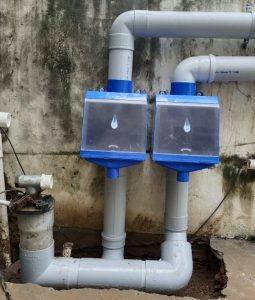
NeeRain is a rooftop rainwater filtration system designed specifically to:
- Increase borewell life
- Reduce the risk of borewell drying
- Protect your pump and plumbing from unnecessary stress
- Help you avoid expensive borewell failure
How it fits into your building (plain words)
NeeRain is:
- Gravity-based (no electricity required)
- Automatic (works during rain without manual effort)
- Compact and easy to install
- Designed to connect to your existing rooftop rainwater pipeline
- Built to filter rooftop rainwater before it goes into borewell recharge
Core message:
A small installation today can extend your borewell life for years.
Why it helps (benefit-first)
1) Recharge during every rainfall event
The biggest reason borewells “die slowly” is lack of consistent recharge. NeeRain makes recharge happen whenever it rains.
2) Healthier water levels = less pump stress
With better water availability:
- The motor struggles less
- Pumping time can reduce
- Dry-run events can reduce
- Breakdown risk goes down
This is a direct pathway to extend borewell lifespan.
3) Fewer “sudden failures”
Most failures are not sudden—they’re the final step of a long decline. Recharge interrupts that decline.
4) Better long-term reliability (especially in summer)
When you improve the water balance around your borewell, you build a buffer for late-summer performance and reduce panic-tanker weeks.
Prevention vs replacement (the cost reality)
If you do nothing, you may face:
- New borewell drilling: ₹1–3 lakh+
- Deeper drilling attempts (sometimes multiple)
- Rising summer tanker costs (recurring)
- Pump repairs due to dry-run stress
- Disruption, uncertainty, and wasted time
If you act early:
- A one-time installation can start recharge during rains
- Reduce long-term failure risk
- Protect the borewell’s useful life
Prevention is often 10x cheaper than replacement.
The Truth Made Simple: A Real-World Example
Imagine a house with 1,500 sq.ft rooftop and a city with a decent monsoon is what needed to harvest rainwater and save borewell. Even a conservative capture-and-recharge approach can add a meaningful amount of water back into your borewell recharge cycle over the season.
The goal isn’t just litres.
The goal is years—years added before your borewell becomes a ₹3 lakh emergency.
The Truth About Delay: Recharge Late, Regret Life time
- “It’s working fine for now.” The decline is gradual—until it isn’t.
- Recharging doesn’t feel like “maintenance.” It’s underground and invisible, so it gets ignored.
- Action happens only after failure. But recharge works best when started early.
Conclusion
Your borewell isn’t just a pipe in the ground. It’s an asset that supports your daily life, your building’s stability, and your peace of mind.
Don’t wait for failure. Recharge your borewell before it runs dry.
If you want to increase borewell life, reduce tanker dependence, and avoid expensive drilling, a simple rooftop rainwater filtration + recharge system is one of the smartest steps you can take.
Call to action
Protect your borewell today.
Explore NeeRain’s simple rooftop rainwater filtration system and take the first step to extend your borewell lifespan—before summer forces your hand.