Month: October 2026

Why Is Your Borewell Water Hard? And Can Rain Really Help?

Look at the tap in your bathroom. Not the shiny part, the base of it, where the water drips and dries.

If you live on borewell water, there’s a fair chance you’ll see a white, chalky crust there. The same crust is probably inside your kettle. It may be on the heating rod of your geyser, on the glass shower door, on the steel sink, and on the bottom of the vessel you boil milk in. You scrub it off, and a few weeks later it’s back.

Most of us don’t think of this as a water problem. We think of it as a cleaning problem, and we buy a stronger descaler. But the crust isn’t dirt. It’s what’s left behind when hard water dries, and it comes from the water itself, which means it starts underground, long before it reaches your tap.

This post is about that. Why is borewell water hard? How is it connected to the falling water tables we’ve talked about in earlier posts? And can sending rain back into your borewell actually make the water better, and not just give you more of it? The honest answer is “often, slowly, and not always”, and we’ll explain exactly what that means.

 What “hard water” actually means

Hard water is simply water with a lot of dissolved minerals in it, mainly calcium and magnesium. You can’t see them. The water looks clear and usually tastes fine. But when it’s heated or when it dries, those minerals come out of the water and stick to whatever they’re on. That’s the white crust.

Hardness is measured in milligrams per litre (mg/L), which is the same as “parts per million” (ppm). You’ll sometimes see it written as hardness “as calcium carbonate”.

The Bureau of Indian Standards, in its drinking water standard (IS 10500), sets 200 mg/L as the acceptable limit for total hardness. Where no better source is available, it allows up to 600 mg/L. Many water-treatment companies describe the rough bands like this, which is a handy guide even if the exact cut-offs vary slightly between sources:

Water in some parts of India, including areas of Rajasthan, Gujarat, Haryana and Madhya Pradesh, is commonly reported to fall in the hard to very hard range when it comes from borewells. But this varies enormously, even between two streets in the same city, which is why the only number that matters is the one from your own tap.

How do you know your water is hard?

You don’t need a lab for a first guess. Look for these everyday signs:

  • White, chalky crust on taps, shower heads, and the edges of sinks.
  • Scale inside the kettle or on the geyser’s heating element, which also makes the geyser work harder and take longer to heat.
  • Soap and shampoo that don’t lather well, so you end up using more of them.
  • A dull, filmy feel on glassware, steel utensils, and bathroom tiles after they dry.
  • White spots on car windows and paint after washing with borewell water.
  • Clothes that feel stiff or look dull after washing.

Is hard water harmful?

For most people, hardness is mainly an everyday nuisance, not an emergency. The big costs are in scale on appliances, more soap and detergent, geysers and pumps that work harder, and a lot of scrubbing. The calcium and magnesium themselves are minerals the body also gets from food.

That said, hardness often travels with other things in borewell water, such as high total dissolved solids (TDS), which we’ll come to in a moment. If you have specific health questions about your water, or if it tastes or smells unusual, the right step is a proper lab test and a conversation with a doctor, not a blog post.

Why does borewell water get hard in the first place?

Here’s the thing most people don’t realise: water that falls as rain is almost completely free of minerals. It’s about as close to distilled water as nature gets. We described this in an earlier post, where we followed a single raindrop from a cloud to a tap.

Everything changes once that water goes underground. As it soaks down through soil and rock, and as it moves slowly through the water-bearing layers your borewell draws from, it dissolves a little of whatever it touches. Rocks and soils rich in calcium and magnesium, such as limestone and many kinds of rock found across India, hand over those minerals to the water, bit by bit.

Two things make the effect stronger:

  • Water that has sat underground for a long time has had longer to dissolve minerals.
  • A geologist quoted in a news report on the Mangalore region said borewells up to about 100 feet are generally fine, but deeper ones tend to carry more calcium, magnesium and other salts. That’s one person’s observation of one region, not a universal rule, but it matches what many borewell owners notice.

So hardness is not something added to your water by a pipe or a pump. It’s the water’s memory of the rock it spent years inside.

The link to a falling water table

This is where hardness connects to everything else we’ve written in this series.

When a water table falls, a borewell stops giving water. The usual response is to drill deeper, chasing the water that’s left. But deeper water is often older water that has been in contact with rock for longer. So a household can end up trading a quantity problem for a quality problem: more water from further down, but harder, saltier water.

Over-pumping an aquifer can also concentrate the salts left in it. Less fresh water coming in, and the same minerals sitting in a smaller volume of water, means a stronger “mineral soup”.

In other words, the same habit that empties a borewell can also make what’s left of it harder. And that means that putting fresh water back into the ground doesn’t just address the quantity side. It also gives the quality side a chance to improve.

How rain can help: the strong-chai idea

Picture a cup of very strong tea, so strong you can barely drink it. What’s the easiest way to make it gentler? Add plain water.

You haven’t removed anything from the tea. You’ve just spread the same tea across more water, so each sip is weaker.

That’s the basic idea behind rain softening groundwater. Rain has almost no dissolved minerals. When you send it down towards your borewell, it mixes with the mineral-rich water already there and dilutes it. Same minerals, more water, lower concentration. The mineral count per litre drops.

It’s a simple mechanism, and it doesn’t need any special technology. It’s also why the effect, when it happens, is gradual. You’re not filtering the minerals out of the ground. You’re slowly changing the balance of the water that surrounds your borewell, one monsoon at a time.

What does the evidence actually say?

Here’s where we want to be careful and honest, because this is the part of the story that is easiest to oversell.

A study in Delhi. Researchers studied groundwater at 15 housing societies in Dwarka, Delhi, each with a rainwater harvesting pit, taking samples across 2004 and 2005. They reported that hardness, TDS and several other measures fell noticeably when rainwater mixed into the groundwater during the monsoon. The study did have limits: it had no comparison group of sites without pits, and the detailed before-and-after numbers weren’t fully reported, so it points in the right direction without proving how big the effect is.

A car-service workshop in Mangalore. A news report described a vehicle-servicing outlet that had a borewell with a recharge pit around its casing. White patches had been appearing on the cars it washed, caused by salts left behind as hard water dried. According to the firm’s manager, the patches stopped once rainwater was diluting the borewell water. This is one business’s own account, with no test readings quoted, so it’s an illustration, not proof.

Housing complexes in Ahmedabad. A news report in Ahmedabad, reproduced on NeeRain’s own site, quoted several housing complexes about TDS after recharge projects. One chairman said TDS had dropped from about 1,100 ppm to about 800 ppm. Others said the water felt “lighter” or that TDS had come down, without new figures. These are self-reported and not independent tests.

Put together, the honest summary is this: the mechanism is sound, several small studies and many first-hand accounts point the same way, and NeeRain’s own view is that recharge improves the quality of borewell water as well as the quantity. But the evidence is mostly small studies and self-reported results, not large controlled trials. We’d rather tell you that plainly than promise a specific number.

A quick note on TDS and hardness

You’ll hear two terms in this conversation, and they get mixed up.

  • Hardness is specifically about calcium and magnesium.
  • TDS (total dissolved solids) counts everything dissolved in the water, including calcium and magnesium but also salts like chloride and sulphate.

They usually rise and fall together, because the same minerals drive both, but they aren’t identical. A cheap handheld TDS meter measures TDS, while hardness needs a test kit or strips, or a lab test. For tracking your own water over time, either one is useful.

Why it takes time, and why it won’t be perfect

If this sounds too good, here are the honest limits.

Groundwater is shared. The water under your house is part of a larger body of water under your street. Rain you send down mixes into that larger body, so the dilution happens across the whole neighbourhood, not just your pipe.

Dilution has limits. If your borewell water is very hard, the amount of rain you can send down in a monsoon may only soften it a little in the first year. And if the recharged water then moves through the same mineral-rich rock, it can pick up minerals again.

The effect builds over seasons. Like everything else in recharge, this is a long game. One monsoon rarely transforms water. Several monsoons, with more fresh water going down each time, are what change the picture

It isn’t a water softener. If your water is very hard today and you need relief this month, recharge isn’t a quick fix. Treatment equipment at the tap deals with the symptom now. Recharge works on the source over time. They solve different problems, and you may reasonably want both while the source improves.

How to see whether it’s working at home

The good news is that you don’t have to trust anyone’s word, including ours. You can measure your own water. Here’s a simple plan that costs very little:

  1. Before the monsoon, test your borewell water. Use a handheld TDS meter, hardness test strips, or a lab test if you want more accuracy. Write the reading down with the date.
  2. Note the everyday signs too. How quickly does scale build up in your kettle? How much soap does it take for a decent lather? Even a rough note helps.
  3. After the monsoon, test again, in the same way and from the same tap, ideally after letting the borewell run for a few minutes.
  4. Repeat before the next monsoon, and again after.
  5. Keep a simple record, like this:

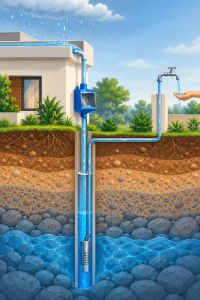
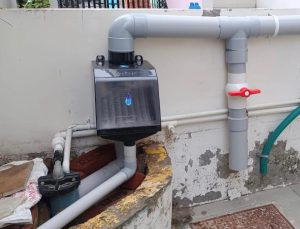
NeeRain is designed to put clean rainwater back into your borewell. It connects to the downpipe you already have, filters leaves, dust and grit out of the rain as it passes through, and guides the clean water down towards your borewell. There’s no electricity, no moving parts, and no digging up the compound, and a local plumber can usually fit it in a short visit.

The filter matters for quality as well as quantity. Rainwater is only soft and clean if it arrives clean, so catching the debris first is what lets that fresh, mineral-free water do its job underground instead of bringing problems with it.

NeeRain’s own view is that this improves the quality of borewell water, not just how much of it there is. The sensible way to find out whether that holds true for your borewell is the home test above. If you’re already tracking your recovery time using the test from our earlier posts, add the TDS or hardness reading to the same notebook. One page, three seasons, and you’ll know.

Questions people often ask

Does boiling the water remove hardness? Only partly. Boiling removes a kind of hardness called temporary hardness, which is why the scale forms in the kettle. It doesn’t remove the rest, called permanent hardness. So boiling is not a complete fix.

Will recharge make my water completely soft? Very unlikely, and nobody should promise that. The realistic hope is a gradual drop in hardness and TDS over several seasons, with the size of the change depending on your local ground and how much rain you send down.

Can recharge make water quality worse? If unfiltered, dirty water goes down, yes, which is why a proper filter is the most important part of any setup. Clean, filtered roof water is the right input. Dirty runoff from the ground or roads is not.

Should I test my water before starting? Yes, if you can. A starting reading is the only way to know whether anything changed later, and it only takes a few minutes.

I already use a water softener or RO. Do I still need this? They do different jobs. Treatment equipment cleans the water at your tap. Recharge improves the source it comes from, and also brings back the quantity. Many households want both.

A short checklist

  • Look for the signs of hard water in your home, and note which ones you see.
  • Get a starting reading for TDS or hardness before the next monsoon.
  • Make sure only clean, filtered roof water is going towards your borewell.
  • Record your borewell’s recovery time and your water reading in the same notebook.
  • Re-test after each monsoon, from the same tap, in the same way.
  • Be patient: think in seasons, not weeks.

The bottom line

The white crust on your tap is a message from underground. It says your water has spent a long time in contact with mineral-rich rock, and that the water around your borewell is concentrated, not fresh.

Rain is the one free source of water with almost no minerals in it, and most of it currently runs down the drain. Sending it back into the ground near your borewell is the simplest way to start changing the balance. It won’t be instant, and it won’t be perfect, but it works on the source, and it’s the one step that can improve both how much water you get and what’s in it.

Take a starting reading this week, before the next monsoon. Then you’ll have your own answer, in your own numbers, and you won’t need to take anyone’s word for it.

The True Cost of a Dry Summer: What a Weak Borewell Really Costs You?

Think back to the last time your borewell struggled.

Maybe it was April. The motor was running longer than usual before any water came up. The tank on the terrace was only half full by evening. You made a call, booked a tanker, waited, and eventually the water arrived. A few days later the pressure improved a little, and life went back to normal. You paid the tanker, paid the electricity bill, and moved on.

Most of us remember a dry summer as an inconvenience. Very few of us ever add it up. And when you do add it up, the real cost is usually bigger than the single tanker bill you remember, and it tends to repeat every year.

This post is a plain, honest walk through what a dry summer actually costs a household that depends on a borewell. It uses real price ranges where they exist, includes a worked example, and ends with a simple worksheet so you can find your own number.

First, an honest note about prices

Costs vary a lot from city to city, and even from street to street. A tanker that costs one amount in Bengaluru can cost very different amounts elsewhere, and prices usually rise when summer gets harsh and everyone is booking at once. So treat the figures below as examples to give you a sense of scale, not as quotes. The worksheet near the end lets you replace them with your own bills.

Cost 1: The tanker

This is the one everybody remembers, so let’s start here.

As an example, a Bengaluru news report from March 2025 put the price of a 6,000-litre tanker at roughly ₹600 to ₹650, and a 12,000-litre tanker at around ₹1,400. Those are the rates the residents were quoted at the start of that summer.

Now let’s see what that means for a family. Earlier posts on this blog used the common planning figure of about 135 litres per person per day. For a family of four, that’s around 540 litres a day. If your borewell can’t meet the family’s needs for 90 days of a bad summer, that’s about 48,600 litres, or roughly four 12,000-litre tankers. At the Bengaluru rate above, that comes to about ₹5,500 to ₹6,000.

That’s an honest number, and it isn’t dramatic. If tankers were the only cost, many households would shrug and pay it. The trouble is that tankers are almost never the only cost. They’re the first line of a longer invoice.

Cost 2: Your pump, working overtime

When water levels drop, a borewell pump has to work harder. It runs longer to fill the same tank, it may run when there’s less water around it, and it ends up on and off more often as the water recovers slowly between draws.

None of that is good for a pump. A pump that has been strained for several summers is more likely to burn out, wear down, or need repairs. According to a borewell cost guide published by JK Cement, a submersible pump alone can cost between ₹18,000 and ₹70,000, depending on its size and type. That is before the electrical panel and wiring, which the same guide puts at ₹15,000 to ₹40,000.

Not every dry summer ends with a new pump, of course. But the risk goes up each year the water level keeps falling, and when a pump does fail, the bill arrives suddenly and in one piece.

Cost 3: The electricity bill nobody connects to the borewell

This one is easy to miss, because it hides inside a monthly bill that has many other things in it.

A pump that runs longer to deliver the same water uses more electricity. It’s a small amount each day, but it’s repeated every day of a long summer. You won’t see a line on your electricity bill that says “borewell struggling,” which is why most people never connect the two.

Cost 4: Going deeper, or going again

This is the big one, and it’s what happens when a borewell finally gives up or stops being worth patching.

The usual response is to deepen it or drill a new one. The same JK Cement guide puts the overall cost of a residential borewell, at 300 to 600 feet and including equipment, at roughly ₹1.5 lakh to ₹5 lakh. Drilling alone is quoted at about ₹120 to ₹350 per foot depending on whether the ground is soil or hard rock. Those are indicative figures, and your local price may differ.

Here’s the part that deserves a pause. Drilling deeper doesn’t fix the cause. A deeper borewell chases a falling water table, which means it may only buy a few more years before the same problem returns. It’s a bit like moving your bucket further down the well instead of asking why the water is dropping.

Cost 5: Everything else that quietly adds up

There’s a layer of smaller costs that rarely get counted:

  • Buying drinking or cooking water when the borewell water is low or muddy.
  • Extra storage, such as larger tanks or drums, bought to cope with irregular supply.
  • Plumber visits for pressure problems that keep coming back.
  • Cleaning and repairs when a low borewell pulls up more silt than usual.

Individually, these are small. Over a few summers, they stop being small.

Cost 6: The cost you can’t put a price on

Then there is time and stress. Waiting at home for a tanker to arrive. Rationing water within the family. Calling the same supplier again and again. Planning the week around when the water is available. None of this shows up on a receipt, but anyone who has lived through a bad summer knows it’s the part that wears you down.

Putting it together: three kinds of dry summer

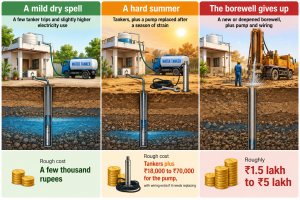
Using only the ranges above, here’s how the cost can climb depending on how bad the summer gets. These are illustrative, and your own figures will differ.

Notice that the first row is something most families can absorb without much thought. The second and third rows are where the real money is, and they don’t arrive with a warning. They arrive after several summers of the water table slowly dropping, when the borewell finally can’t cope.

A household over five summers (an illustration)

Numbers in a table are easy to skim past, so let’s follow one imaginary household across five dry summers. This is an illustration built from the example ranges above, not a prediction, and not every borewell follows this path. Some recover, some fail sooner. But it shows how the costs stack.

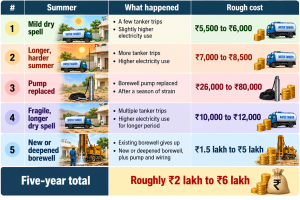
Summer 1: a mild dry spell. The pump runs a little longer and the tank is slow to fill by April. The family books about four tankers over the season. Cost: roughly ₹5,500 to ₹6,000, at the example Bengaluru rates.

Summer 2: a little harder. The slow-filling starts a few weeks earlier than last year, and the dry stretch lasts around four months. That’s about 65,000 litres of extra water needed, or five to six tankers. Cost: roughly ₹7,000 to ₹8,500.

Summer 3: the pump gives up. After two seasons of working harder than it was built to, the pump burns out in May. The family pays for tankers again, and for a replacement pump. Cost: tankers of about ₹8,000 to ₹10,000, plus ₹18,000 to ₹70,000 for the pump.

Summer 4: stable, but fragile. The new pump works well, but the water table keeps dropping underneath it. Tankers are needed earlier and for longer. Cost: roughly ₹10,000 to ₹12,000.

Summer 5: the borewell fails. Pressure collapses in March, and a technician says it’s no longer worth repairing. The family drills a new borewell or deepens the old one. Cost: roughly ₹1.5 lakh to ₹5 lakh.


Look at where the money actually went. In years one, two and four, the family paid a few thousand rupees and barely noticed. Nearly all the cost landed in years three and five, in two sudden, large bills. That’s why a dry summer is so easy to underestimate. The small bills look harmless, and the big ones arrive without much warning.

Why it keeps repeating

Here’s the pattern worth noticing. A dry summer isn’t a one-time event for most borewells. It’s a symptom of a water table that’s falling year after year, which means the next summer is usually a little harder than this one, not easier.

So the real cost isn’t one bad summer. It’s the same set of costs, repeated and gradually growing, until the day the borewell stops being usable at all.

Your own number: a quick worksheet

You don’t need exact figures for this. Rough numbers from memory are enough. Write down:

  1. Tanker trips last summer × the price you paid per trip.
  2. Pump repairs or replacement in the last three years, with the amounts.
  3. Extra electricity in summer months compared with the rainy months. A rough guess is fine.
  4. Plumber or repair visits related to water pressure.
  5. Drinking or cooking water bought separately.
  6. Any deepening or redrilling you’ve done in the past, however long ago.

Add the six lines. Then multiply the yearly part by the number of years you expect to live in the house. That’s the real price of doing nothing, and it’s a number most people have never seen written down.

“But tankers are cheap, so why bother?”

It’s a fair objection, and the numbers above show why people make it. If a mild summer costs a few thousand rupees in tankers, it can feel silly to spend anything to avoid it.

Here is an honest answer in three parts.

First, you’re right about the mild years. If your borewell will stay healthy enough that only a few tankers a year are ever needed, tanker costs on their own are not a strong reason to do anything.

Second, the problem isn’t the tanker. It’s the cliff behind it. The tanker is the comfortable part of the story. The pump replacement and the new borewell are where the real money is, and a falling water table is what leads there. Recharge isn’t aimed at the tanker bill. It’s aimed at the water table that eventually forces the bigger bills.

Third, tankers carry costs that aren’t on the receipt. You wait for them. You depend on a supplier showing up on a day when everyone else is also calling. And you often can’t tell where the water came from, so it may be fine for washing and not what you want for cooking. A borewell that holds up is simply more convenient, and more predictable, than a phone call.

Where recharge changes the picture

Recharge works on the cause, not on the symptoms. Instead of paying for tankers, pumps and deeper drilling every time the water table drops, you put water back into the ground near your borewell every monsoon, so the level your borewell depends on has a chance to hold up or recover.


A NeeRain setup does this by connecting to the downpipe you already have, filtering the rain as it passes through, and guiding the clean water down towards your borewell. It needs no electricity, has no moving parts, and doesn’t need the compound dug up. It’s a one-time cost, ask the NeeRain team for a quote for your roof, and you can then compare it with the worksheet number above. For many households, that comparison is the moment the decision gets easier.

An honest caveat belongs here, as it does in every post on this blog. Recharge is not a guarantee. Groundwater is shared across a neighbourhood, results depend on local ground conditions, and a single monsoon rarely undoes years of decline. What recharge does is add to the underground water every year, and over several seasons that tends to show up as a borewell that recovers faster and holds out longer into summer. Measuring your borewell’s recovery time before and after the monsoon is the simplest way to see whether it’s working for you.

Questions readers often ask

Will recharge end my tanker bills completely? Honestly, it can’t promise that. Groundwater is shared across a neighbourhood, and results depend on local ground conditions. What recharge aims to do is reduce how often you need tankers over time, and, more importantly, reduce the chance of reaching the expensive end of the table.

How soon will I see a difference? Usually not in a single monsoon. Water takes time to soak down and spread through the ground, and years of decline don’t reverse in one season. Think in seasons, and measure your borewell’s recovery time before and after each monsoon so you can see your own progress.

What if my borewell is already very weak? Recharge works best when there’s still a working borewell to top up. If yours is still giving water, even weakly, that’s the right time to start, since waiting only lets the water table fall further. If it has already failed completely, it’s worth getting it checked by a borewell technician before deciding anything.

Is it worth it if I might move in a few years? The setup stays with the property, and a house with a borewell that holds up through summer is easier to live in, and to sell or rent out, than one with a borewell that struggles. It’s worth weighing against how long you expect to stay, and your worksheet number will help.

Do I have to do anything every year? Yes, a little. A filter needs a quick clean before and after each monsoon, which takes a few minutes. It’s far less effort than managing tankers.

The bottom line

A dry summer doesn’t cost one tanker bill. It costs a tanker bill, a strained pump, a larger electricity bill, a pile of small extras, and sometimes a new borewell, repeated year after year while the water table keeps dropping.

Write your own number down this week. Seeing the total on paper is often the moment people stop treating a dry summer as bad luck and start treating it as a problem with a fix. And the best time to start is before the next monsoon, so that the first big rain goes back into your borewell instead of down the drain.


Following a Drop of Rain: From Your Roof to Your Tap

Somewhere above your house right now, a cloud is carrying water that evaporated from the ocean weeks ago, drifted hundreds of kilometres on the wind, cooled, condensed, and gathered into the grey mass sitting over your city today. In a few minutes, one drop out of that enormous mass is going to fall on exactly one square metre of your roof. It has no idea that’s about to happen. It’s just rain, doing what rain has done for longer than houses have existed.

But what happens to that drop in the next few minutes and the next few months depends entirely on something your house either has or doesn’t have. Let’s follow it all the way from the cloud to your tap, and see exactly where the choices get made.

The fall

The drop leaves the cloud and falls for several seconds, picking up a trace of dust from the air on the way down, but otherwise arriving about as clean as water gets anywhere in nature. It hasn’t touched soil. It hasn’t passed through a single pipe. It hasn’t sat in a tank absorbing whatever a tank absorbs over time. For this one brief moment, it is purer than almost any other water your house will see all year.

It lands on your roof and joins a thin, fast-moving sheet of water already spreading across the surface thousands of drops just like it, all moving the same way, pulled downhill by gravity toward the lowest edge of the roof and the open mouth of your downpipe. If you’ve ever stood under an awning during a heavy shower and watched that sheet rushing past, you’ve watched exactly this moment happen, probably without thinking about where any of it was actually going.

The first choice

Here’s where the story splits, and this is the part almost no household ever stops to consider. For the overwhelming majority of roofs in India, this moment is the end of the journey that actually matters. The water reaches the downpipe, drops straight down, hits the ground, and runs along the compound into a drain. From there it joins the stormwater system, leaves the property, leaves the street, and often leaves the neighbourhood entirely. It might eventually reach a river. It might sit in a drain somewhere far away, doing nothing useful for anyone. Either way, it has nothing more to do with the borewell your own house depends on every single day.

That’s not a failure of the rain. The rain did exactly what rain does it fell, and it followed gravity. It’s a failure of the pipe it fell into having nowhere better to send it.

In a house set up for recharge, though, the drop’s journey is only just getting started.

The filter

Instead of running straight to the drain, the drop is intercepted along with the rest of the roof’s runoff and guided through a filtration unit mounted on the downpipe. This is the point where a NeeRain filter does its work. As the water passes through, leaves, dust, and the fine grit that accumulated on the roof since the last rain get caught and separated out, while the cleaned water continues on its way down, pipe to pipe, toward the ground.

This step matters far more than it looks like it should. Unfiltered runoff carries exactly the kind of debris that clogs pipes, silts up the soil around a recharge point, and over time can even work its way into the borewell it’s supposed to be helping. The drop that emerges from the filter isn’t just rainwater anymore. It’s rainwater that’s genuinely safe to send underground, instead of a mix of water and roof grime that could do more harm than good.

The dirtiest drops never make it

Not every drop that reaches the filter is treated the same way, and that’s deliberate. The very first rain of each shower sometimes the first rain of the whole monsoon, after a long dry summer carries far more dust and grime than anything that falls after it, simply because it’s washing months of accumulated roof grit away in one go. A well-designed system quietly diverts this dirtiest portion away before it ever reaches the filter properly, the same instinct as rinsing a glass before you actually fill it.

Our drop might be one of the lucky ones that falls twenty minutes into a downpour, well after that first dirty rush has already been sent elsewhere. Or it might be one of the first drops of the season, quietly rejected and sent straight to the drain, never getting the chance to start the longer journey at all. Either way, this small, almost invisible sorting decision is happening constantly, every single time it rains, long before anyone outside is even thinking about where the water is going.

The disappearance

From the filter, the drop travels down a final stretch of pipe and arrives at the point where it’s released into the soil, close to your borewell. And here, for a while, it simply disappears from view.

This is the part of the journey nobody ever gets to watch, which might be exactly why it’s the part people trust the least. The drop moves downward through layers of soil and rock, pulled by gravity, spreading sideways a little as it travels, gradually becoming part of a much larger, almost entirely invisible body of water sitting underground. That underground water, often called an aquifer, is the same water table your borewell has been quietly drawing from for years a layer of soaked, saturated earth rather than a cave or an underground lake, holding water the way a sponge holds water rather than the way a bottle does.

It doesn’t happen instantly. Depending on the type of soil, it can take anywhere from a few days to several weeks for a drop to properly settle into that layer. But it does happen, and it’s the exact same basic process that has been filling underground water supplies since long before anyone ever dug a well or installed a pump. The only thing that’s changed is that this particular drop was given a cleaner, more direct path than it would have found wandering through open, uneven ground on its own.

The wait

This is the longest part of the story, and also the quietest. The drop joins thousands of others just like it, sitting in the ground, in absolutely no hurry. It might get pulled up through your borewell next week. It might still be sitting there next summer. It might even end up drawn toward a neighbour’s borewell instead of yours, since groundwater doesn’t recognise property boundaries the way compound walls and fences do it simply moves toward wherever it’s being drawn from hardest.

This is also exactly what makes recharge a long game rather than an instant fix. One monsoon’s worth of drops won’t undo years of decline by itself, any more than a single deposit clears a long-overdue overdraft. But every monsoon that sends water down this path instead of out to a drain adds a little more to what’s waiting underground, and over several seasons, that steady accumulation is precisely what turns a struggling borewell back into a reliable one.

A tale of two roofs

Picture two houses on the same street, built the same year, drawing from borewells that tap into the same underground layer of water. One has a downpipe that simply ends at the ground, the way most houses do. The other has a filter fitted to its downpipe, quietly sending cleaned rainwater down near its borewell every time it rains.

For the first year or two, you’d barely notice a difference between them. Then a dry summer arrives, a little harsher than the ones before it. In the first house, the pump runs longer, the pressure thins out earlier in the season, and the family starts eyeing the calendar nervously each April. In the second house, the borewell still dips a little groundwater is shared, after all, and no single roof controls the whole street’s water table but it recovers faster, holds its flow a little longer, and the dry season feels less like an emergency and more like business as usual.

Neither family did anything dramatic. One of them just gave a few thousand drops, every monsoon, a better place to go than the drain.

It was never really about one drop

Zoom out from our single drop for a moment, and the real scale of this starts to show. One roof doesn’t produce one drop in a monsoon it produces millions of them, falling over months, each one facing the same fork between drain and filter. A modest house can realistically send well over a lakh litres down that second path in a single year, as earlier posts on this blog have worked out in detail.

Now zoom out further. That same choice is being made, or not made, on every roof on your street, above the same shared layer of underground water that all of your borewells draw from. A single house doing this is a quiet, private improvement. A whole street doing it, roof after roof, is the difference between a neighbourhood’s water table slowly recovering and one that keeps sliding in the same direction it always has. Our one drop was never really the point it was just the easiest way to see, up close, a decision that only matters once it’s repeated millions of times over, on roof after roof, monsoon after monsoon.

The return

Eventually, your pump switches on. Somewhere in the underground water your borewell draws from, our drop or more realistically, a vast number of others just like it gets pulled upward through the casing pipe, pushed through your household plumbing, and arrives, finally, at your tap, your shower, or the bucket you’re filling for the evening.

It’s worth pausing on just how long that journey actually was. Cloud to roof. Roof to filter. Filter to soil. Soil to aquifer. Aquifer to pump. Pump to tap. Most households only ever witness the very first step and the very last one rain falling outside the window, and water coming out of a tap indoors with no idea that everything in between either happened quietly and well, or never happened at all, depending on one connection that was or wasn’t made.

What decides the whole story

The entire difference between the two versions of this journey drop to drain, or drop to tap, months later, exactly when it’s needed comes down to one decision, made once, at the single point where a downpipe either ends at a drain or continues on through a filter and down into the ground. Nothing about the rain changes between the two outcomes. Nothing about the borewell changes either. The only thing that changes is whether that one connection exists.

This is really the entire idea behind borewell recharge, told as a story instead of a statistic: it isn’t a complicated intervention, and it isn’t asking the rain to do anything it wasn’t already willing to do. It’s simply giving it a better path to follow one that ends, eventually, back in your own borewell, instead of disappearing down a drain and out of your life for good.

The bottom line

Every monsoon, your roof plays host to millions of drops exactly like the one we just followed. Most of them, in most houses, take the short and forgettable route roof to drain, and gone for good. A much smaller number, in the houses that bothered to make one simple connection, take the longer, quieter route roof to filter to ground to borewell to tap and come back, months later, to be useful at exactly the moment it matters most.

The rain isn’t the variable in this story. You are.