Month: September 2026

How Much Water Could You Put Back into Your Borewell Every Monsoon? A Simple Way to Find Out

Think of your borewell as a bank account.

Every single day, you make withdrawals. Bathing, cooking, washing, filling the tank. The motor runs, water comes up, and the balance underground goes down a little.

Deposits, on the other hand, are rare. For most borewells, they happen only when it rains, and even then, most of the rain never makes it into the account. It runs off roads, roofs and open ground, into drains, and out of your neighbourhood completely.

So the balance drops, year after year, until one summer the motor runs longer, the pressure feels weak, and the tank takes forever to fill. Nobody made one big mistake. The withdrawals just outpaced the deposits for a long time.

This post is about the deposit side. How much water could you actually be sending back into your borewell each monsoon? The answer is usually much bigger than people expect, and you can work it out yourself in about five minutes.
Where your borewell’s deposit comes from

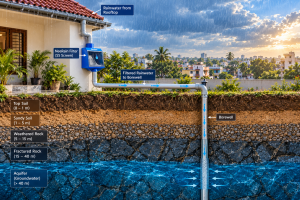
Rain falls on your roof whether you do anything about it or not. Every drop that lands on your terrace is water that could go back into the ground near your borewell, instead of into the drain.

That is what borewell recharge means. It’s simply guiding that rooftop water, after filtering out leaves and dust, down into the underground layer your borewell draws from. That layer works like a natural sponge, and it soaks up the water and holds it for you to use later.

So the number you’re about to calculate is your borewell’s yearly deposit potential: the litres you could be returning to your own water supply every monsoon.

The one fact that makes the sum easy

One millimetre of rain falling on one square metre of surface equals exactly one litre of water.

That’s the whole secret. So you only need two things:

  1. How big is your roof? More roof, more water.
  2. How much does it rain in a year where you live? More rain, more water.

Multiply them, and you have your number.

Step 1: Find your roof area

Measure the flat top of your house, as if you were looking straight down at it. A roof that is 30 feet by 40 feet is 1,200 square feet. If you don’t know it, your ground-floor built-up area is a good stand-in, since the roof above it is usually about the same size.

The rule above works in square metres, so convert once: 1 square foot is about 0.093 square metres. A 1,200 sq ft roof is roughly 111 square metres.

Step 2: Find your yearly rainfall

Every city has an average annual rainfall in millimetres. Search “average annual rainfall” with your city’s name, and you’ll find it. To give you a feel for the range across India (these vary year to year, so treat them as rough):

  • Drier regions: often 400 to 700 mm a year
  • Moderate regions: around 800 to 1,200 mm
  • Wet regions: 2,000 mm or more

Step 3: Do the sum

Roof area (in square metres) × yearly rainfall (in mm) = litres of rain landing on your roof.

Example: a 1,500 sq ft roof in a city with 1,000 mm of rain a year

  • 1,500 sq ft × 0.093 = about 139 square metres
  • 139 × 1,000 mm = about 1,39,000 litres

That is roughly 1.4 lakh litres falling on one ordinary roof in one year.

A reality check: not every drop makes it in

Some water splashes off the edges, some soaks into the roof, and the first bit of each rain is usually sent away on purpose because it carries all the dust that settled since the last shower. A safe rule of thumb is that around 80% of the rain can realistically be guided towards your borewell.

So for our example: 1,39,000 × 0.8 = about 1,11,000 litres of yearly deposit potential.

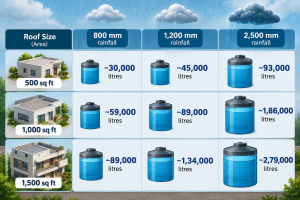
Quick reference: what different roofs could send to a borewell

These figures assume about 80% of the rain is guided in.

What that number means for your borewell
Big numbers are hard to picture, so here are two comparisons:

  • Tanker loads: A typical water tanker carries roughly 10,000 litres, though sizes vary. So 1.3 lakh litres is about thirteen tanker loads, the kind many families end up buying every summer.
  • Your family’s use: Indian town planning assumes roughly 135 litres per person per day. For a family of four, that’s around 2 lakh litres a year. So 1.3 lakh litres is close to eight months of that family’s total water use.

Now, an honest note. Not every litre you send down will come back out of your own borewell. Groundwater is shared. It spreads through the soil and rock under your street, and how much of it reaches your borewell depends on your local ground conditions. This is why recharge is a long game. It’s a deposit into a shared account, and the effect builds over seasons rather than arriving in a single monsoon. But when a whole street or housing society does it, the shared account fills up much faster than any single house could manage.

How does the water actually get into the borewell?

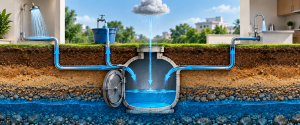
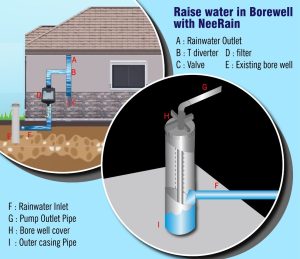
It’s simpler than most people imagine. The rain lands on your roof and runs into your downpipe, the way it always does. Before it reaches the drain, it passes through a filter that catches leaves, dust and grit. The clean water is then guided down into the ground close to your borewell, rather than out to the drain.
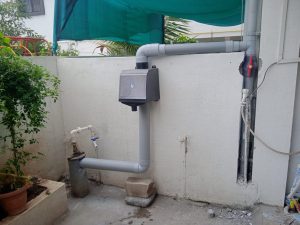
This is exactly what a NeeRain filter does. It connects to the downpipe you already have, cleans the rain as it flows through, and sends it towards your borewell. There is no electricity to run, no moving parts to service, and no digging up your compound. It mounts on the wall or pipe, and a local plumber can usually set it up in a short visit. The ground itself does the storing, so there’s no tank taking up space either.

Thousands of households using NeeRain have already done this. Instead of losing their roof’s water to the drain, they send it back into their own borewell, and each monsoon adds a little more to the supply they’ll rely on months later.

How will you know it’s working?

You don’t need instruments. You can use the same simple test from our earlier post on borewell trouble signs:

  1. Let the borewell rest for a few hours, then time how long it takes to give a full, normal flow again.
  2. Write that time down.
  3. Repeat it after the monsoon, and again next summer.

Over a few seasons, a borewell that is being recharged tends to recover faster and hold its flow longer into summer. That is the real evidence, and it’s easy to see because it’s your own number, measured against your own past.

What about apartments and housing societies?

If you live in a flat, the roof belongs to the whole building, and that helps. A society’s roof is usually large, so the yearly deposit is large too. A building with a 5,000 sq ft roof and 1,000 mm of rain, for example, has around 3.7 lakh litres of yearly potential.

The catch is that the decision has to be made together, usually through the resident welfare association. But the cost is shared across many flats, and the borewell being topped up is the one they all depend on. A NeeRain setup can be fitted to the building’s main downpipes, so nothing changes inside any individual flat.

Your 5-minute checklist

  1. Measure or estimate your roof area in square feet, then multiply by 0.093 for square metres.
  2. Look up your city’s average yearly rainfall in millimetres.
  3. Multiply the two to get the litres landing on your roof each year.
  4. Multiply by 0.8 to get a realistic yearly deposit for your borewell.
  5. Compare it with your family’s yearly water use (about 135 litres per person per day).
  6. Do the borewell recovery test now, so you have a starting point to compare against after the monsoon.
  7. Ask NeeRain which setup suits your roof at neerain.com, and get it in place before the next monsoon arrives.

The bottom line

Your borewell has been making withdrawals every day of the year, while its deposits depend on rain that mostly runs away. Your roof is the biggest deposit slip you own. Work out how many litres it could send back this monsoon, and you’ll see how much of your borewell’s future is sitting right above your head. With NeeRain, the first big rain of next year can go into your borewell instead of the drain.
 

Signs Your Borewell Needs Recharge, Not a New Pump

Picture this. You turn on the tap one morning and the water just trickles out, slower than usual. You check the tank it’s taking longer to fill than it did last month. A few days of this, and you call a plumber. He looks at the motor, maybe changes a part, maybe replaces the whole pump. For a few weeks, everything feels normal again.

Then, a season or two later, the exact same thing happens. Weak pressure. Slow filling. Same complaint, almost word for word.

At this point, most people think one of two things: either they got a bad pump, or they got a bad plumber. What almost nobody stops to ask is a much simpler and more useful question what if the pump was never actually the problem in the first place?

Here’s why that question matters. A pump’s only job is to push water up from underground. It doesn’t create water. It can’t make water appear if there isn’t enough of it down there to begin with. So if there’s simply less water underground than there used to be, a shiny new pump will run into the exact same wall the old one did. It might take a little longer to hit that wall, but it will hit it.

Why everyone blames the pump first and why that’s an easy mistake to make?

This isn’t a silly mistake. It’s actually a very natural one. A pump is something you can see, touch, and hear. It has a motor that gets warm, it makes a sound when it’s running, and when it breaks, it usually breaks in a way that’s obvious it stops working, or it makes a strange noise.

The water table meaning the underground level at which water sits, waiting to be pumped up is nothing like that. You can’t see it. You can’t hear it. It doesn’t announce itself with a bang or a burning smell. It just quietly gets lower, year after year, without telling anyone. So naturally, when something goes wrong, people blame the part they can actually point to. The pump gets blamed, gets replaced, and the real cause a shrinking water supply underground never gets looked at, let alone fixed.

What a genuine pump problem actually looks like!

Let’s first talk about how to recognise when it really is the machine, so you’re not left guessing. A true pump problem usually shows up suddenly, not slowly. Some signs to watch for:

  • It goes from fine to not-fine overnight. Yesterday it worked. Today it doesn’t start at all, or it keeps tripping your electricity supply.
  • Strange sounds. Grinding, humming without any water actually coming out, or a motor that sounds like it’s straining hard to do its job.
  • It gets hot fast. If you touch the motor casing after only a short run and it’s uncomfortably hot, that’s a sign of mechanical strain, not a water shortage.
  • Pressure that changes randomly, not seasonally. If your water pressure is sometimes fine and sometimes weak with no pattern tied to the weather or time of year, that points to the equipment, not the ground beneath it.

If what you’re noticing matches this list, it’s genuinely worth calling a plumber. The machine really might be the issue.

What a water-table problem looks like instead

Now here’s the other kind of problem the one caused by less water being available underground, not by anything wrong with the pump itself. This one behaves almost the opposite way: slow, seasonal, and steady, rather than sudden and random.

  • It gets a little worse every year, not all at once. The pressure this summer is a bit weaker than last summer, which was a bit weaker than the summer before that.
  • It takes longer to “come back.” If you draw water for a while and then stop, the borewell needs some time to refill before it can give you a full flow again. If that recovery time keeps stretching out 20 minutes last year, 40 minutes this year that’s the underground water level dropping, not the pump wearing out.
  • The bad season starts earlier each year. If weak pressure used to begin in April and now starts showing up in February, something underground has genuinely shifted.
  • Your neighbours are complaining too. This is one of the most reliable clues of all. A pump breaking down is a random, private event it happens to one house, not the whole street. But if several homes on the same road or in the same housing society are all noticing the same seasonal weakness at roughly the same time, that’s not a coincidence of everyone’s pumps failing together. That’s a shared pool of underground water technically called an aquifer, but you can just think of it as the underground “tank” that all the nearby borewells are drawing from running low for everyone at once.
  • The pump itself is behaving perfectly. No strange noise, no tripping, no overheating. It’s just moving less water, or taking longer to start moving any water at all.

If most of what you’re seeing matches this second list, especially the bit about neighbours, you are very likely dealing with a water-table problem not a machine problem.

Why getting this wrong is an expensive mistake taking this lighthlty

Here’s the part that actually costs people money. If you replace a pump when the real issue is the water level underground, you don’t just waste the price of the new pump. You lose something more valuable: time. A newer, stronger pump can often squeeze a little more water out of a shrinking supply for a few weeks, which feels like the problem is “fixed.” Then the same weakness comes back, because the actual cause less water underground was never touched.

Now imagine this happening across an entire street or housing society, with each household separately buying a new pump for what is, underneath all of them, the exact same shared water shortage. That’s a lot of money spent on machines, and none of it aimed at the thing that’s actually running low.

A simple test you can do yourself, no tools needed

You don’t need any special equipment for this just a little patience.

  1. Let your borewell rest for a few hours without drawing any water from it say, overnight or during a work day.
  2. When you next use it, time how long it takes before the flow feels “normal” again.
  3. Write that time down.
  4. Do the exact same test again in three or four weeks.

If the recovery time stays roughly the same or gets a bit better, your equipment is a fair suspect if something goes wrong later. But if that recovery time keeps getting longer each time you check regardless of how well the pump seems to be running you’re looking at a water-table problem, and no amount of pump-shopping is going to solve it.


So what actually fixes this, if it is the water table?

If your symptoms point toward the ground running low rather than the machine failing, the answer isn’t a stronger pump it’s putting more water back underground near your borewell than is currently going in on its own. That’s what a recharge system does. Instead of letting rain run off your roof and disappear down a drain, it’s filtered and guided down into the ground close to where your borewell draws its water from so the underground “tank” your borewell depends on gets topped up instead of just being steadily drained.

Think of it a bit like a bucket with a small hole in the bottom. You can keep buying bigger cups to scoop water out faster, or you can pour a little water back in every time it rains. Only one of those two actually keeps the bucket from running dry.

A recharge system won’t undo years of decline in a single monsoon. But it treats the actual cause instead of just working around it with a bigger, stronger pump which is really the whole difference between solving a problem and simply postponing it.

A quick way to sum it all up

  • Sudden breakdown, strange noise, overheating, random tripping → probably the pump. Call a plumber.
  • Slow decline over several years, longer recovery time, neighbours seeing the same pattern, pump itself running fine → probably the water table. A new pump won’t fix this.
  • Not sure which one it is? Run the simple rest-and-recovery test above once now, and once again in a few weeks, before spending money on either fix.
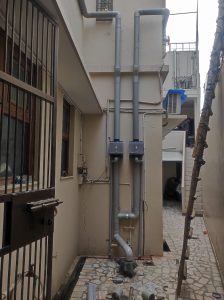
    look at device try and understand

The bottom line

A pump usually tells you clearly when it’s the problem with a noise, a smell, a sudden stop. A dropping water table doesn’t say anything at all. It just quietly gives you a little less water every year, until the symptoms look exactly like a machine wearing out. Before you spend money on your next pump, take five minutes to figure out which one you’re actually dealing with. It could be the difference between genuinely fixing the problem and just buying yourself a few more weeks with it.

This is exactly the gap a NeeRain recharge setup is built to close. Thousands of families have already connected their rooftop to their borewell this way so instead of a season’s rain running off and disappearing down a drain, it gets filtered and sent straight back underground, right where their own borewell draws from. It won’t undo years of decline in a single monsoon. But monsoon after monsoon, it adds up. The borewell recovers a little faster, holds out a little longer into summer, and keeps giving better water for longer than it would have been left to manage on its own.

The Groundwater Report Card: What India’s Latest Numbers Mean for Your Borewell

There’s a particular sound that a lot of Indian households have learned to notice without really thinking about it: the motor running just a little longer than it used to before water starts flowing. Nobody logs the exact date it started happening. It’s more of a slow suspicion that builds over a couple of summers the pressure feels weaker, the tank takes longer to fill, and somewhere in the back of your mind you start wondering if it’s the pump, or the pipes, or something underground you can’t see.

Turns out, there’s an actual government agency whose entire job is answering that question. Once a year, the Central Ground Water Board sits down with every state government and measures, block by block, exactly how much groundwater is going into the earth versus how much is being pulled out. It’s the closest thing India has to a report card for its water table and unlike your borewell’s slow-motion mystery, this one comes with real numbers.

The latest edition of that report card has a genuinely encouraging headline. It also has a set of numbers buried underneath that headline that every borewell-owning household should sit with for a minute, because the national average is quietly hiding a very local, very personal story.

The good news you don’t hear often enough

Let’s start with the part that doesn’t usually make it into the doom-and-gloom water-crisis conversation, because it’s actually good news. In 2017, just over 17% of India’s groundwater “assessment units” the blocks, taluks, and mandals used to carve up the country for measurement purposes were classified as “over-exploited,” meaning more water was being pumped out each year than nature was putting back in. By the 2024 assessment, that number had fallen to around 11%. The share of units in the healthy “safe” category climbed from roughly 63% to over 73% over the same stretch. Recharge is up nationally. Extraction is down. And more than two crore water conservation and artificial recharge structures have gone up under government programmes like the Jal Shakti Abhiyan in the years in between.

Sit with that for a second, because it’s easy to scroll past a statistic like that without registering what it actually means: a resource that a lot of people have quietly assumed is on a one-way trip to zero is, in aggregate, moving in the other direction. That’s not something that happens by accident. It happens because recharge deliberately, physically putting water back underground faster than it’s being taken out works, at a scale large enough to bend a national number.

The part the average doesn’t tell you

Here’s where the story gets more complicated, and more relevant to whatever’s happening under your own street. An 11% national over-exploitation rate doesn’t mean 11% of the country is in trouble and the rest is coasting along fine. It means the crisis hasn’t disappeared it’s just concentrated, geographically, in the same handful of places, year after year.

The government’s own assessment names three clusters where this concentration is heaviest: the north-west (Punjab, Haryana, Delhi, western Uttar Pradesh), the west (Rajasthan and Gujarat), and pockets of the south (Karnataka, Tamil Nadu, Telangana, Andhra Pradesh). Karnataka alone reported over 39,000 square kilometres classified as overexploited as of March 2024 a scale that has barely budged year over year, even while the country’s overall number has been improving.

So if you live in or near one of these clusters, “the national trend is improving” isn’t reassurance. It’s almost the opposite it’s a sign that the improvement is happening somewhere else, and your local aquifer might be one of the ones still moving the wrong way while the national average gets to celebrate.

What “over-exploited” actually feels like from your terrace

The technical term behind all of this is the “stage of groundwater extraction” essentially, how much water is being pumped out compared to how much is naturally replenished, shown as a percentage. Cross 100%, and a region is spending down a resource faster than it’s earning it back, the same way a bank balance drops when withdrawals outpace deposits, month after month, without anyone noticing until the balance is uncomfortably low.

Delhi’s number in 2017 was 119.61%. Read that again slowly: nearly a fifth more water was being pulled out of the ground every year than was going back in. That’s not an abstract policy failure that kind of sustained deficit is precisely what pushes borewells deeper, dries up the shallow ones first, and quietly turns a source you never had to think about into one you check anxiously every March.

The proof that recharge actually works not just the theory

Here’s the part of the data that should genuinely change how you think about this. Delhi’s extraction stage that alarming 119.61% in 2017 had fallen to 100.77% by 2024, and to 92.10% in the most recent assessment. For the first time in years, Delhi is drawing less water than it’s putting back. Himachal Pradesh’s turnaround is even steeper: from 86.37% in 2017 down to 38.50% today.

Neither of those numbers moved because the monsoon suddenly got generous. They moved because artificial recharge structures and interventions built specifically to route water back underground faster than it’s being pulled out was applied deliberately, and at scale. And here’s the thing worth pausing on: that’s the exact same physical principle behind a rooftop rainwater harvesting system on an ordinary house. Intercept water that would otherwise run off down a drain, and send it underground instead. Delhi just did it with government-scale infrastructure. Your roof can do a smaller version of the same thing, starting this monsoon.

Why the fix is local, even though the headlines are national

There’s one more number worth knowing, because it changes how you should think about your own role in all of this: 87% of India’s extracted groundwater goes to agriculture, and only around 11% goes to domestic use. It’s tempting to read that and conclude that a single household’s water use and by extension, a single household’s recharge effort is a rounding error next to the country’s irrigation demand. Why bother, if agriculture is the real story?

That reasoning misunderstands how groundwater actually moves. An aquifer isn’t a single national tank that everyone draws from equally it’s local, often specific to a neighbourhood or even a single street’s underlying soil and rock. Your borewell isn’t competing with a wheat field three states away. It’s sharing a small, local pocket of water with your actual neighbours’ borewells. Recharging that pocket even from a handful of rooftops on your street changes the water table your own home depends on far more directly, and far faster, than any national irrigation policy ever will on a timeline you’d actually notice.

How a rooftop actually becomes a recharged borewell

The mechanism, once you see it, is almost embarrassingly simple and it’s the same mechanism behind Delhi’s and Himachal Pradesh’s improving numbers, just shrunk down to the size of a single home. Rain lands on your roof. It’s filtered to strip out leaves, dust, and roof grit. Instead of running off the edge of the terrace and into a storm drain which is what happens to it right now, on most homes it’s redirected down into the existing borewell, where it percolates into the ground almost exactly the way natural rainfall recharge does, except with far less lost to evaporation or surface runoff along the way.

Over a full monsoon, that adds up to something real. A modest roof in a moderate-rainfall city can route tens of thousands of litres back underground in a single season and multiplied across a street, or a housing society, that’s a small but genuine local echo of the exact intervention that pulled Delhi’s number back under 100%.

Where to start, in practical terms

  • Find out where you actually stand. CGWB’s state-wise assessment data is public a few minutes of searching tells you whether your district falls in a safe, semi-critical, or over-exploited zone, and how urgent this really is for your specific location.
  • Pay attention to what your borewell is already telling you. A pump running longer than it used to, a slower recovery time after use, or a dry spell showing up earlier in summer than last year are all early symptoms of exactly the same deficit playing out under your own property.
  • Get your roof’s catchment looked at. Connecting an existing downpipe to a filtered recharge line is a plumbing and filtration question not a construction project, and not something that requires re-engineering your home.
  • Talk to a local installer before the next monsoon arrives, not during it. Every season you wait is a season of rainfall that ran off unused instead of going back into the ground you’re going to need it in.

The bottom line

The 2024 assessment isn’t a feel-good statistic to skim past it’s documented proof that groundwater recovery is achievable, because it’s already happening in places that did the work. The national trend is genuinely, measurably positive. Whether your household gets to be part of that story, or stays part of the older one, comes down to something far more local than any government report: what happens on your own roof, the next time it rains.


Running Dry in the Diamond City: How Rooftop Rainwater Harvesting Can Solve Surat’s Water Crisis

Gujarat and Surat: A State Under Water Stress

It’s easy to assume that water scarcity is a rural, drought-belt problem. It isn’t. Gujarat has repeatedly been flagged as one of India’s most water-stressed states, and the reasons are structural, not seasonal.

Groundwater not rainfall or rivers is what actually keeps Indian cities running day to day. Nationally, groundwater accounts for the overwhelming majority of domestic water supply and irrigation, which means when it runs low, everything from drinking water to industry feels the pinch.

Gujarat’s version of this problem has a well-documented cause. Decades of free or heavily subsidised electricity for agricultural groundwater pumping encouraged farmers to draw far more water than aquifers could naturally replenish, steadily lowering the water table across the state. Gujarat has repeatedly been described as one of India’s most water-stressed states because of this unsustainable groundwater use.

Surat sits right in the middle of this stress. The city’s rapid population growth and its massive textile and diamond-processing industries put enormous, continuous demand on the Tapi River and on groundwater reserves. Surat’s textile units alone were, at one point, drawing around 60 million litres of potable water a day just for fabric processing a scale of consumption that pushed the Surat Municipal Corporation to invest in recycled water supply for over a hundred industrial units in the GIDC area, simply to take pressure off the freshwater system.

The pattern is familiar in urban India: paved surfaces and concrete stop rain from soaking into the ground, so instead of recharging aquifers, monsoon water rushes into storm drains and out to sea often causing flooding on its way out. The city gets a deluge for a few months and a shortage for the rest of the year. Surat is not water-poor by nature. It is water-poor by design, because so little of the rain that falls on it is ever captured.

How much rain does Surat actually get?

This is the part that surprises most people. Surat is not a low-rainfall city. Government hydrological data for Surat district puts the long-term normal annual rainfall at a little over 1,200 mm, with average annual rainfall estimates in some years reaching close to 1,400 mm most of it concentrated into roughly three monsoon months between June and September. That is a substantial amount of water arriving on rooftops, roads, and open ground every single year.

To put that in perspective: a modest 1,000-square-foot (about 93 square metre) rooftop in Surat, in a year with roughly 1,200 mm of rainfall, has the potential to passively collect well over 80,000 litres of water enough to meaningfully supplement a household’s non-drinking water needs for months. Almost none of that potential is currently captured. It runs off roofs, down drains, and out of the city, often contributing to waterlogging on its way rather than doing anyone any good.

That gap between how much rain actually falls and how little of it is used is the single biggest opportunity hiding in plain sight for Surat’s water future.

Why Groundwater Depletion Is Everyone’s Problem

It’s tempting to think of groundwater depletion as an “agriculture issue” or a “government issue.” In reality, it shows up in daily urban life in very concrete ways:

  • Falling borewells and dropping water tables, which means deeper (and costlier) drilling for the same amount of water.
  • Salinity and water quality problems, as depleted freshwater aquifers along the coast become more vulnerable to seawater intrusion a real risk for a coastal city like Surat.
  • Rising dependence on tankers and municipal supply, which strains civic infrastructure and household budgets alike.
  • Urban flooding, ironically caused by the same impermeable surfaces that prevent groundwater recharge rain has nowhere to go but the streets.
  • Higher long-term costs for industry, as textile and processing units are pushed toward expensive recycled-water infrastructure to meet demand sustainably.
  • Seasonal water stress, where a city can experience both flooding in August and water shortages in April a sign that the problem isn’t rainfall, it’s storage and recharge.

None of this is inevitable. It is the predictable result of capturing almost none of the rain that falls on rooftops, roads, and open ground each monsoon. Every one of these problems has the same root cause, and every one of them is, at least partially, addressable at the level of an individual building.

Rainwater Harvesting: A Solution Hiding in Plain Sight

Rainwater harvesting is not a new or exotic idea India has traditional rainwater capture systems going back centuries, from taankas in Rajasthan to ahar-pynes in Bihar to stepwells across Gujarat itself. These weren’t backup systems; for generations, they were the primary water infrastructure for entire towns, engineered with a sophistication that modern urban planning has, in many places, simply abandoned in favour of pumped groundwater and piped supply.

What’s changed today is the setting: the easiest place to capture rainwater isn’t a village pond or a stepwell, it’s the rooftop of a home, apartment building, or factory shed surfaces that already exist, that already funnel water somewhere, and that simply need to be pointed in a smarter direction.

How a rooftop RWH system actually works

The logic of rooftop RWH is simple, and it usually comes down to four stages:

  1. Collection rain falling on the roof is directed by the natural slope of the structure toward the edges.
  2. Conveyance gutters and downpipes carry that water from the roof to ground level (or to a nearby storage point) instead of letting it splash off uncontrolled.
  3. Filtration before the water goes anywhere useful, it passes through a filter that removes leaves, dust, bird droppings, and other rooftop debris. This step is what separates a system that works reliably for years from one that clogs within a season.
  4. Storage or recharge the filtered water is then either:
    • Stored in a tank for direct use (washing, gardening, flushing, vehicle washing, and with additional treatment drinking), or
    • Recharged into the ground through a percolation pit, soak pit, or recharge well, replenishing the very aquifer that borewells draw from.

Many buildings actually benefit from doing both: storing enough for immediate use, and diverting any overflow to recharge structures so that excess monsoon water isn’t wasted even after the tank is full.

Storage systems vs. recharge systems which one do you need?

This is one of the most common points of confusion for homeowners and housing societies, so it’s worth being direct about it:

  • Storage systems make the most sense where piped or tanker water is unreliable or expensive, and where the harvested water will be used relatively quickly (within days or weeks) for non-drinking purposes.
  • Recharge systems make more sense where the priority is long-term groundwater health for properties with their own borewell, or in neighbourhoods where community groundwater levels have visibly dropped.
  • Combined systems storage plus recharge give you the best of both: usable water now, and a healthier water table for later. For most mid-sized residential buildings in Surat, this hybrid approach tends to offer the most value for the investment.

The benefits compound quickly regardless of which setup you choose. Rooftop RWH reduces dependence on rivers, municipal supply, and groundwater; it lowers the volume and speed of stormwater runoff, which helps prevent urban flooding; and it can make water available even in areas where piped supply is unreliable. Because harvested rainwater is naturally low in salinity and contaminants once properly filtered, it’s also considered a genuinely economical water source in cities where tariffs on treated water keep rising.

Recognising this, Surat Municipal Corporation has made rooftop rainwater harvesting mandatory for larger new buildings under Gujarat’s municipal building regulations, with subsidy schemes offered at various points to encourage adoption. That’s a meaningful policy signal but plenty of homes, smaller housing societies, and independent buildings fall outside that mandate, and could still benefit enormously from installing their own systems voluntarily.

The Missing Piece: Why the Filter Matters

Here’s where many rooftop RWH systems quietly fail not because rainwater harvesting doesn’t work, but because unfiltered or poorly filtered systems let debris, silt, and organic matter into storage tanks or recharge pits. Over time this means clogged pipes, contaminated stored water, and recharge structures that stop working exactly when they’re needed most. A recharge pit clogged with silt after two monsoons is worse than no recharge pit at all it gives a false sense of security while doing almost nothing.

This is the specific problem NeeRain’s rooftop rainwater harvesting filters are built to solve. Instead of treating filtration as an afterthought, NeeRain places it at the center of the system:

  • First-flush and debris separation capturing leaves, dust, and rooftop grime before water ever reaches your tank or recharge pit, so the system keeps working efficiently monsoon after monsoon.
  • Consistent, low-maintenance filtration designed so households and societies aren’t stuck constantly desilting tanks or unclogging pipes.
  • Compatibility with both storage and recharge setups whether the goal is usable water for daily needs or replenishing the groundwater under your own property, a clean input makes the whole system more reliable.
  • A practical fit for Surat’s building stock from independent homes to apartment complexes and industrial sheds, sized to match rooftop area and expected monsoon rainfall.

In a city where every borewell is competing with thousands of others for the same shrinking aquifer, a household or society that filters and recharges its own rooftop rainwater is, in effect, giving back to the very groundwater system it depends on rather than only ever taking from it.

What good maintenance looks like

Even the best filter needs a little seasonal attention, and being upfront about this is part of setting realistic expectations:

  • Pre-monsoon check clearing gutters and downpipes of any debris that accumulated over the dry months, before the first rains arrive.
  • First-flush diversion the very first rainfall after a long dry spell carries the most rooftop dust and pollutants; a good system diverts this initial flow away from storage.
  • Periodic filter cleaning a quick clean-out during the monsoon keeps flow rates high and prevents overflow bypassing the filter entirely.
  • Post-monsoon inspection checking that stored water looks and smells normal, and that recharge pits are draining at a healthy rate rather than pooling.

None of this is technically demanding it’s closer to cleaning a window AC filter than servicing a car but it does need to actually happen, which is why a well-designed, low-maintenance filter matters so much for long-term reliability.

What This Looks Like in Practice

Picture a mid-sized housing society in Surat with a shared rooftop area of, say, 2,000 square feet. Using Surat’s typical rainfall of over 1,200 mm a year, that rooftop could passively intercept somewhere in the range of 150,000–200,000 litres of rainwater annually water that currently just runs off into the drain. With a NeeRain filter and a simple storage or recharge setup:

  • That water can be filtered and stored for non-drinking daily use cutting dependence on tanker water or over-stressed borewells, especially in the months right after monsoon when demand is high but rain has stopped.
  • Or it can be filtered and recharged directly into the ground, helping stabilise the local water table for everyone drawing from it, not just the society itself.
  • Either way, the same rain that used to contribute to street flooding is instead doing useful work.

Scale that logic down to a single independent home with a smaller rooftop, and the numbers shrink but the principle holds: even a modest home can meaningfully supplement its water use or contribute to local groundwater recharge, at a fraction of the cost of drilling a new borewell or relying indefinitely on tanker deliveries.

Multiply this across residential societies, commercial complexes, and factory rooftops across Surat, and the cumulative effect on the city’s water balance is significant exactly the kind of decentralised, resident-led action that complements (and goes beyond) what municipal mandates alone can achieve.

The Economics: Why This Pays for Itself

For many households, the deciding factor isn’t the environmental argument it’s the financial one, and rooftop RWH tends to hold up well on that front too:

  • Lower recurring costs. Every litre harvested and used is a litre that doesn’t need to be bought from a tanker or drawn (at rising energy cost) from a deepening borewell.
  • One-time investment, multi-year returns. Unlike tanker water, which is a recurring cost that never ends, a rooftop RWH system is largely a one-time investment with years of usable life ahead of it.
  • Lower borewell maintenance. Recharging your own groundwater can help maintain the yield of an existing borewell, delaying or avoiding the cost of re-drilling deeper as water tables fall.
  • Property value and compliance. For larger properties, having a functioning RWH system already in place also means being ahead of Surat’s building regulations rather than scrambling to retrofit one later.

The exact payback period depends on rooftop size, current water costs, and how much of the harvested water actually gets used versus simply recharged but the direction of the economics is consistent: capturing free water that’s already falling on your roof is almost always cheaper, over time, than continuing to pay for water that has to be pumped, trucked, or drilled for.The Takeaway

Surat’s water problem isn’t a lack of rain it’s a lack of capture. The city receives well over a thousand millimetres of rainfall most years, more than enough to meaningfully ease its water stress, yet Gujarat’s groundwater has been under strain for decades, industry and population growth keep raising demand, and impermeable urban surfaces send most monsoon rainfall straight into drains instead of aquifers. Rooftop rainwater harvesting, done right, reverses that pattern at the household and building level turning three months of monsoon into a year-round buffer against scarcity.

The “done right” part is where filtration makes all the difference and it’s exactly where NeeRain’s rooftop RWH filters fit in, turning an ordinary rooftop into a small, dependable part of the solution to Surat’s water future.

References

  1. India Water Portal “Gujarat among the most water-starved states in India: UN” (on Gujarat’s groundwater depletion and Surat’s shift to recycled industrial water). indiawaterportal.org
  2. India Water Portal “New technology adoption in rural areas of emerging economies: The case of rainwater harvesting systems in India” (on the benefits and adoption of rooftop rainwater harvesting). indiawaterportal.org
  3. Centre for Science and Environment (CSE) “Laws and Policy” on rainwater harvesting mandates across Indian cities, including Surat Municipal Corporation’s rules. cseindia.org
  4. Central Ground Water Board, Government of India District Ground Water Brochure, Surat District, Gujarat State (on normal and average annual rainfall for Surat district). cgwb.gov.in