
There’s a particular sound that a lot of Indian households have learned to notice without really thinking about it: the motor running just a little longer than it used to before water starts flowing. Nobody logs the exact date it started happening. It’s more of a slow suspicion that builds over a couple of summers the pressure feels weaker, the tank takes longer to fill, and somewhere in the back of your mind you start wondering if it’s the pump, or the pipes, or something underground you can’t see.
Turns out, there’s an actual government agency whose entire job is answering that question. Once a year, the Central Ground Water Board sits down with every state government and measures, block by block, exactly how much groundwater is going into the earth versus how much is being pulled out. It’s the closest thing India has to a report card for its water table and unlike your borewell’s slow-motion mystery, this one comes with real numbers.
The latest edition of that report card has a genuinely encouraging headline. It also has a set of numbers buried underneath that headline that every borewell-owning household should sit with for a minute, because the national average is quietly hiding a very local, very personal story.
The good news you don’t hear often enough
Let’s start with the part that doesn’t usually make it into the doom-and-gloom water-crisis conversation, because it’s actually good news. In 2017, just over 17% of India’s groundwater “assessment units” the blocks, taluks, and mandals used to carve up the country for measurement purposes were classified as “over-exploited,” meaning more water was being pumped out each year than nature was putting back in. By the 2024 assessment, that number had fallen to around 11%. The share of units in the healthy “safe” category climbed from roughly 63% to over 73% over the same stretch. Recharge is up nationally. Extraction is down. And more than two crore water conservation and artificial recharge structures have gone up under government programmes like the Jal Shakti Abhiyan in the years in between.
Sit with that for a second, because it’s easy to scroll past a statistic like that without registering what it actually means: a resource that a lot of people have quietly assumed is on a one-way trip to zero is, in aggregate, moving in the other direction. That’s not something that happens by accident. It happens because recharge deliberately, physically putting water back underground faster than it’s being taken out works, at a scale large enough to bend a national number.
The part the average doesn’t tell you
Here’s where the story gets more complicated, and more relevant to whatever’s happening under your own street. An 11% national over-exploitation rate doesn’t mean 11% of the country is in trouble and the rest is coasting along fine. It means the crisis hasn’t disappeared it’s just concentrated, geographically, in the same handful of places, year after year.
The government’s own assessment names three clusters where this concentration is heaviest: the north-west (Punjab, Haryana, Delhi, western Uttar Pradesh), the west (Rajasthan and Gujarat), and pockets of the south (Karnataka, Tamil Nadu, Telangana, Andhra Pradesh). Karnataka alone reported over 39,000 square kilometres classified as overexploited as of March 2024 a scale that has barely budged year over year, even while the country’s overall number has been improving.
So if you live in or near one of these clusters, “the national trend is improving” isn’t reassurance. It’s almost the opposite it’s a sign that the improvement is happening somewhere else, and your local aquifer might be one of the ones still moving the wrong way while the national average gets to celebrate.
What “over-exploited” actually feels like from your terrace
The technical term behind all of this is the “stage of groundwater extraction” essentially, how much water is being pumped out compared to how much is naturally replenished, shown as a percentage. Cross 100%, and a region is spending down a resource faster than it’s earning it back, the same way a bank balance drops when withdrawals outpace deposits, month after month, without anyone noticing until the balance is uncomfortably low.
Delhi’s number in 2017 was 119.61%. Read that again slowly: nearly a fifth more water was being pulled out of the ground every year than was going back in. That’s not an abstract policy failure that kind of sustained deficit is precisely what pushes borewells deeper, dries up the shallow ones first, and quietly turns a source you never had to think about into one you check anxiously every March.
The proof that recharge actually works not just the theory
Here’s the part of the data that should genuinely change how you think about this. Delhi’s extraction stage that alarming 119.61% in 2017 had fallen to 100.77% by 2024, and to 92.10% in the most recent assessment. For the first time in years, Delhi is drawing less water than it’s putting back. Himachal Pradesh’s turnaround is even steeper: from 86.37% in 2017 down to 38.50% today.
Neither of those numbers moved because the monsoon suddenly got generous. They moved because artificial recharge structures and interventions built specifically to route water back underground faster than it’s being pulled out was applied deliberately, and at scale. And here’s the thing worth pausing on: that’s the exact same physical principle behind a rooftop rainwater harvesting system on an ordinary house. Intercept water that would otherwise run off down a drain, and send it underground instead. Delhi just did it with government-scale infrastructure. Your roof can do a smaller version of the same thing, starting this monsoon.
Why the fix is local, even though the headlines are national
There’s one more number worth knowing, because it changes how you should think about your own role in all of this: 87% of India’s extracted groundwater goes to agriculture, and only around 11% goes to domestic use. It’s tempting to read that and conclude that a single household’s water use and by extension, a single household’s recharge effort is a rounding error next to the country’s irrigation demand. Why bother, if agriculture is the real story?
That reasoning misunderstands how groundwater actually moves. An aquifer isn’t a single national tank that everyone draws from equally it’s local, often specific to a neighbourhood or even a single street’s underlying soil and rock. Your borewell isn’t competing with a wheat field three states away. It’s sharing a small, local pocket of water with your actual neighbours’ borewells. Recharging that pocket even from a handful of rooftops on your street changes the water table your own home depends on far more directly, and far faster, than any national irrigation policy ever will on a timeline you’d actually notice.
How a rooftop actually becomes a recharged borewell
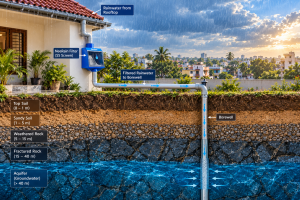
The mechanism, once you see it, is almost embarrassingly simple and it’s the same mechanism behind Delhi’s and Himachal Pradesh’s improving numbers, just shrunk down to the size of a single home. Rain lands on your roof. It’s filtered to strip out leaves, dust, and roof grit. Instead of running off the edge of the terrace and into a storm drain which is what happens to it right now, on most homes it’s redirected down into the existing borewell, where it percolates into the ground almost exactly the way natural rainfall recharge does, except with far less lost to evaporation or surface runoff along the way.
Over a full monsoon, that adds up to something real. A modest roof in a moderate-rainfall city can route tens of thousands of litres back underground in a single season and multiplied across a street, or a housing society, that’s a small but genuine local echo of the exact intervention that pulled Delhi’s number back under 100%.
Where to start, in practical terms
- Find out where you actually stand. CGWB’s state-wise assessment data is public a few minutes of searching tells you whether your district falls in a safe, semi-critical, or over-exploited zone, and how urgent this really is for your specific location.
- Pay attention to what your borewell is already telling you. A pump running longer than it used to, a slower recovery time after use, or a dry spell showing up earlier in summer than last year are all early symptoms of exactly the same deficit playing out under your own property.
- Get your roof’s catchment looked at. Connecting an existing downpipe to a filtered recharge line is a plumbing and filtration question not a construction project, and not something that requires re-engineering your home.
- Talk to a local installer before the next monsoon arrives, not during it. Every season you wait is a season of rainfall that ran off unused instead of going back into the ground you’re going to need it in.
The bottom line
The 2024 assessment isn’t a feel-good statistic to skim past it’s documented proof that groundwater recovery is achievable, because it’s already happening in places that did the work. The national trend is genuinely, measurably positive. Whether your household gets to be part of that story, or stays part of the older one, comes down to something far more local than any government report: what happens on your own roof, the next time it rains.