
Picture this. You turn on the tap one morning and the water just trickles out, slower than usual. You check the tank it’s taking longer to fill than it did last month. A few days of this, and you call a plumber. He looks at the motor, maybe changes a part, maybe replaces the whole pump. For a few weeks, everything feels normal again.
Then, a season or two later, the exact same thing happens. Weak pressure. Slow filling. Same complaint, almost word for word.
At this point, most people think one of two things: either they got a bad pump, or they got a bad plumber. What almost nobody stops to ask is a much simpler and more useful question what if the pump was never actually the problem in the first place?
Here’s why that question matters. A pump’s only job is to push water up from underground. It doesn’t create water. It can’t make water appear if there isn’t enough of it down there to begin with. So if there’s simply less water underground than there used to be, a shiny new pump will run into the exact same wall the old one did. It might take a little longer to hit that wall, but it will hit it.
Why everyone blames the pump first and why that’s an easy mistake to make?
This isn’t a silly mistake. It’s actually a very natural one. A pump is something you can see, touch, and hear. It has a motor that gets warm, it makes a sound when it’s running, and when it breaks, it usually breaks in a way that’s obvious it stops working, or it makes a strange noise.
The water table meaning the underground level at which water sits, waiting to be pumped up is nothing like that. You can’t see it. You can’t hear it. It doesn’t announce itself with a bang or a burning smell. It just quietly gets lower, year after year, without telling anyone. So naturally, when something goes wrong, people blame the part they can actually point to. The pump gets blamed, gets replaced, and the real cause a shrinking water supply underground never gets looked at, let alone fixed.
What a genuine pump problem actually looks like!
Let’s first talk about how to recognise when it really is the machine, so you’re not left guessing. A true pump problem usually shows up suddenly, not slowly. Some signs to watch for:
- It goes from fine to not-fine overnight. Yesterday it worked. Today it doesn’t start at all, or it keeps tripping your electricity supply.
- Strange sounds. Grinding, humming without any water actually coming out, or a motor that sounds like it’s straining hard to do its job.
- It gets hot fast. If you touch the motor casing after only a short run and it’s uncomfortably hot, that’s a sign of mechanical strain, not a water shortage.
- Pressure that changes randomly, not seasonally. If your water pressure is sometimes fine and sometimes weak with no pattern tied to the weather or time of year, that points to the equipment, not the ground beneath it.
If what you’re noticing matches this list, it’s genuinely worth calling a plumber. The machine really might be the issue.
What a water-table problem looks like instead
Now here’s the other kind of problem the one caused by less water being available underground, not by anything wrong with the pump itself. This one behaves almost the opposite way: slow, seasonal, and steady, rather than sudden and random.
- It gets a little worse every year, not all at once. The pressure this summer is a bit weaker than last summer, which was a bit weaker than the summer before that.
- It takes longer to “come back.” If you draw water for a while and then stop, the borewell needs some time to refill before it can give you a full flow again. If that recovery time keeps stretching out 20 minutes last year, 40 minutes this year that’s the underground water level dropping, not the pump wearing out.
- The bad season starts earlier each year. If weak pressure used to begin in April and now starts showing up in February, something underground has genuinely shifted.
- Your neighbours are complaining too. This is one of the most reliable clues of all. A pump breaking down is a random, private event it happens to one house, not the whole street. But if several homes on the same road or in the same housing society are all noticing the same seasonal weakness at roughly the same time, that’s not a coincidence of everyone’s pumps failing together. That’s a shared pool of underground water technically called an aquifer, but you can just think of it as the underground “tank” that all the nearby borewells are drawing from running low for everyone at once.
- The pump itself is behaving perfectly. No strange noise, no tripping, no overheating. It’s just moving less water, or taking longer to start moving any water at all.
If most of what you’re seeing matches this second list, especially the bit about neighbours, you are very likely dealing with a water-table problem not a machine problem.
Why getting this wrong is an expensive mistake taking this lighthlty
Here’s the part that actually costs people money. If you replace a pump when the real issue is the water level underground, you don’t just waste the price of the new pump. You lose something more valuable: time. A newer, stronger pump can often squeeze a little more water out of a shrinking supply for a few weeks, which feels like the problem is “fixed.” Then the same weakness comes back, because the actual cause less water underground was never touched.
Now imagine this happening across an entire street or housing society, with each household separately buying a new pump for what is, underneath all of them, the exact same shared water shortage. That’s a lot of money spent on machines, and none of it aimed at the thing that’s actually running low.
A simple test you can do yourself, no tools needed
You don’t need any special equipment for this just a little patience.
- Let your borewell rest for a few hours without drawing any water from it say, overnight or during a work day.
- When you next use it, time how long it takes before the flow feels “normal” again.
- Write that time down.
- Do the exact same test again in three or four weeks.
If the recovery time stays roughly the same or gets a bit better, your equipment is a fair suspect if something goes wrong later. But if that recovery time keeps getting longer each time you check regardless of how well the pump seems to be running you’re looking at a water-table problem, and no amount of pump-shopping is going to solve it.
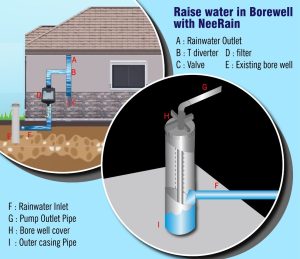
So what actually fixes this, if it is the water table?
If your symptoms point toward the ground running low rather than the machine failing, the answer isn’t a stronger pump it’s putting more water back underground near your borewell than is currently going in on its own. That’s what a recharge system does. Instead of letting rain run off your roof and disappear down a drain, it’s filtered and guided down into the ground close to where your borewell draws its water from so the underground “tank” your borewell depends on gets topped up instead of just being steadily drained.
Think of it a bit like a bucket with a small hole in the bottom. You can keep buying bigger cups to scoop water out faster, or you can pour a little water back in every time it rains. Only one of those two actually keeps the bucket from running dry.
A recharge system won’t undo years of decline in a single monsoon. But it treats the actual cause instead of just working around it with a bigger, stronger pump which is really the whole difference between solving a problem and simply postponing it.
A quick way to sum it all up
- Sudden breakdown, strange noise, overheating, random tripping → probably the pump. Call a plumber.
- Slow decline over several years, longer recovery time, neighbours seeing the same pattern, pump itself running fine → probably the water table. A new pump won’t fix this.
- Not sure which one it is? Run the simple rest-and-recovery test above once now, and once again in a few weeks, before spending money on either fix.
look at device try and understand
The bottom line
A pump usually tells you clearly when it’s the problem with a noise, a smell, a sudden stop. A dropping water table doesn’t say anything at all. It just quietly gives you a little less water every year, until the symptoms look exactly like a machine wearing out. Before you spend money on your next pump, take five minutes to figure out which one you’re actually dealing with. It could be the difference between genuinely fixing the problem and just buying yourself a few more weeks with it.
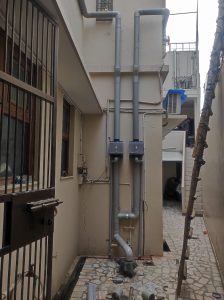
This is exactly the gap a NeeRain recharge setup is built to close. Thousands of families have already connected their rooftop to their borewell this way so instead of a season’s rain running off and disappearing down a drain, it gets filtered and sent straight back underground, right where their own borewell draws from. It won’t undo years of decline in a single monsoon. But monsoon after monsoon, it adds up. The borewell recovers a little faster, holds out a little longer into summer, and keeps giving better water for longer than it would have been left to manage on its own.