
Think of your borewell as a bank account.
Every single day, you make withdrawals. Bathing, cooking, washing, filling the tank. The motor runs, water comes up, and the balance underground goes down a little.
Deposits, on the other hand, are rare. For most borewells, they happen only when it rains, and even then, most of the rain never makes it into the account. It runs off roads, roofs and open ground, into drains, and out of your neighbourhood completely.
So the balance drops, year after year, until one summer the motor runs longer, the pressure feels weak, and the tank takes forever to fill. Nobody made one big mistake. The withdrawals just outpaced the deposits for a long time.
This post is about the deposit side. How much water could you actually be sending back into your borewell each monsoon? The answer is usually much bigger than people expect, and you can work it out yourself in about five minutes.

Where your borewell’s deposit comes from
Rain falls on your roof whether you do anything about it or not. Every drop that lands on your terrace is water that could go back into the ground near your borewell, instead of into the drain.
That is what borewell recharge means. It’s simply guiding that rooftop water, after filtering out leaves and dust, down into the underground layer your borewell draws from. That layer works like a natural sponge, and it soaks up the water and holds it for you to use later.
So the number you’re about to calculate is your borewell’s yearly deposit potential: the litres you could be returning to your own water supply every monsoon.
The one fact that makes the sum easy
One millimetre of rain falling on one square metre of surface equals exactly one litre of water.
That’s the whole secret. So you only need two things:
- How big is your roof? More roof, more water.
- How much does it rain in a year where you live? More rain, more water.
Multiply them, and you have your number.
Step 1: Find your roof area
Measure the flat top of your house, as if you were looking straight down at it. A roof that is 30 feet by 40 feet is 1,200 square feet. If you don’t know it, your ground-floor built-up area is a good stand-in, since the roof above it is usually about the same size.
The rule above works in square metres, so convert once: 1 square foot is about 0.093 square metres. A 1,200 sq ft roof is roughly 111 square metres.
Step 2: Find your yearly rainfall
Every city has an average annual rainfall in millimetres. Search “average annual rainfall” with your city’s name, and you’ll find it. To give you a feel for the range across India (these vary year to year, so treat them as rough):
- Drier regions: often 400 to 700 mm a year
- Moderate regions: around 800 to 1,200 mm
- Wet regions: 2,000 mm or more
Step 3: Do the sum
Roof area (in square metres) × yearly rainfall (in mm) = litres of rain landing on your roof.
Example: a 1,500 sq ft roof in a city with 1,000 mm of rain a year
- 1,500 sq ft × 0.093 = about 139 square metres
- 139 × 1,000 mm = about 1,39,000 litres
That is roughly 1.4 lakh litres falling on one ordinary roof in one year.
A reality check: not every drop makes it in
Some water splashes off the edges, some soaks into the roof, and the first bit of each rain is usually sent away on purpose because it carries all the dust that settled since the last shower. A safe rule of thumb is that around 80% of the rain can realistically be guided towards your borewell.
So for our example: 1,39,000 × 0.8 = about 1,11,000 litres of yearly deposit potential.
Quick reference: what different roofs could send to a borewell
These figures assume about 80% of the rain is guided in.
What that number means for your borewell
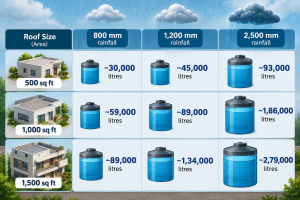
Big numbers are hard to picture, so here are two comparisons:
- Tanker loads: A typical water tanker carries roughly 10,000 litres, though sizes vary. So 1.3 lakh litres is about thirteen tanker loads, the kind many families end up buying every summer.
- Your family’s use: Indian town planning assumes roughly 135 litres per person per day. For a family of four, that’s around 2 lakh litres a year. So 1.3 lakh litres is close to eight months of that family’s total water use.
Now, an honest note. Not every litre you send down will come back out of your own borewell. Groundwater is shared. It spreads through the soil and rock under your street, and how much of it reaches your borewell depends on your local ground conditions. This is why recharge is a long game. It’s a deposit into a shared account, and the effect builds over seasons rather than arriving in a single monsoon. But when a whole street or housing society does it, the shared account fills up much faster than any single house could manage.
How does the water actually get into the borewell?
It’s simpler than most people imagine. The rain lands on your roof and runs into your downpipe, the way it always does. Before it reaches the drain, it passes through a filter that catches leaves, dust and grit. The clean water is then guided down into the ground close to your borewell, rather than out to the drain.
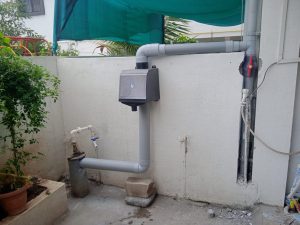
This is exactly what a NeeRain filter does. It connects to the downpipe you already have, cleans the rain as it flows through, and sends it towards your borewell. There is no electricity to run, no moving parts to service, and no digging up your compound. It mounts on the wall or pipe, and a local plumber can usually set it up in a short visit. The ground itself does the storing, so there’s no tank taking up space either.
Thousands of households using NeeRain have already done this. Instead of losing their roof’s water to the drain, they send it back into their own borewell, and each monsoon adds a little more to the supply they’ll rely on months later.
How will you know it’s working?
You don’t need instruments. You can use the same simple test from our earlier post on borewell trouble signs:
- Let the borewell rest for a few hours, then time how long it takes to give a full, normal flow again.
- Write that time down.
- Repeat it after the monsoon, and again next summer.
Over a few seasons, a borewell that is being recharged tends to recover faster and hold its flow longer into summer. That is the real evidence, and it’s easy to see because it’s your own number, measured against your own past.
What about apartments and housing societies?
If you live in a flat, the roof belongs to the whole building, and that helps. A society’s roof is usually large, so the yearly deposit is large too. A building with a 5,000 sq ft roof and 1,000 mm of rain, for example, has around 3.7 lakh litres of yearly potential.
The catch is that the decision has to be made together, usually through the resident welfare association. But the cost is shared across many flats, and the borewell being topped up is the one they all depend on. A NeeRain setup can be fitted to the building’s main downpipes, so nothing changes inside any individual flat.
Your 5-minute checklist
- Measure or estimate your roof area in square feet, then multiply by 0.093 for square metres.
- Look up your city’s average yearly rainfall in millimetres.
- Multiply the two to get the litres landing on your roof each year.
- Multiply by 0.8 to get a realistic yearly deposit for your borewell.
- Compare it with your family’s yearly water use (about 135 litres per person per day).
- Do the borewell recovery test now, so you have a starting point to compare against after the monsoon.
- Ask NeeRain which setup suits your roof at neerain.com, and get it in place before the next monsoon arrives.
The bottom line
Your borewell has been making withdrawals every day of the year, while its deposits depend on rain that mostly runs away. Your roof is the biggest deposit slip you own. Work out how many litres it could send back this monsoon, and you’ll see how much of your borewell’s future is sitting right above your head. With NeeRain, the first big rain of next year can go into your borewell instead of the drain.