
Let’s start with a family that did everything right.
They fixed the dripping kitchen tap the day they noticed it. The kids turn the tap off while brushing. Showers got shorter, the washing machine only runs with a full load, and the garden gets the leftover kitchen water. Over three years, they cut their water use noticeably, and they’re quietly proud of it.
Then, one March, the borewell started to struggle anyway. The motor ran longer. The terrace tank took ages to fill. By April, a tanker was on its way.
If you’ve been through this, you know how unfair it feels. Many people start to doubt themselves: maybe we’re still wasting water, maybe the pump is old, maybe it’s bad luck.
Here’s the honest answer, and it’s a little uncomfortable: your own water use is usually a small part of what’s happening to your borewell. The causes are mostly outside your gate. This post explains what they are, why saving water at home isn’t always enough, and what you can actually do about it. Your borewell is not a private tank.
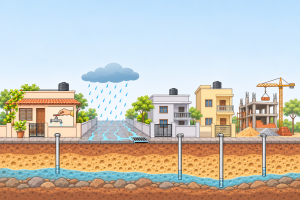
The most important idea in this post is simple: your borewell is not a tank that belongs to you.
It draws from water held in the ground beneath your street. As we’ve said in earlier posts, this isn’t an underground lake. It’s closer to a very large sponge, a layer of soil and rock soaked with water. That sponge doesn’t stop at your boundary wall. It runs under your neighbours’ houses, under the road, and under the farm or factory down the lane. Everyone with a borewell in the area draws from the same sponge.
In earlier posts we compared a borewell to a bank account. Here’s a better picture: it’s a joint account, shared with everyone nearby. You decide how much you take out. You don’t decide how much anyone else does. And the deposits, the rain soaking into the ground, aren’t in your control either, unless you do something about them.
So you can be the most careful person on the street and the account can still run low, because what matters is everyone’s withdrawals against all the deposits.
A quick look at the numbers
A family of four uses roughly 2 lakh litres a year, using the planning figure of 135 litres per person per day from an earlier post. Compare that with the national picture: according to a summary of the Central Ground Water Board’s 2024 reports, about 87% of the groundwater India extracts goes to agriculture and only about 11% to domestic use.
That doesn’t make saving water pointless, as we’ll see. It just means that if you only work on your own use, you’re working on a small part of the withdrawals and none of the deposits.
Cause 1: The ground has been sealed
This is the quietest cause, and probably the biggest in cities and towns.
For most of history, a large part of the rain that fell soaked into the ground. Open soil, grass, fields and village ponds let water in, and that’s how the underground sponge refilled every monsoon.
Now think about how your neighbourhood has changed in twenty years. Open plots have houses, compounds are tiled, mud lanes are concrete, and roads were widened and sealed. Rain that used to soak in now hits a hard surface and runs to a drain.
A World Resources Institute study looked at ten Indian cities, including Ahmedabad and Surat, between 2000 and 2015. It found that built-up area grew by an average of 47% within 20 km of the city centre, and by 134% in the ring 20 to 50 km out. About 44% of new development was built on land with high or very high recharge potential, which is the kind of ground that used to refill the aquifer best. The figures are a decade old, but the direction has continued.
The effect is simple: the rain still falls, but the deposit slip never reaches the account. And your own property is part of this. Your roof sends rain down a pipe. A tiled or concreted compound sends the rest to the drain. A house can send nearly all the rain that falls on its plot straight out of the gate.
Cause 2: More borewells share the same water
When one household drills a borewell, it’s a small thing. When fifty households on a street do, it isn’t.
Every new borewell is another straw in the same glass, and the straws aren’t equal. A deeper borewell with a stronger pump pulls water towards itself, which can lower the level around it, including at shallower borewells nearby. Hydrogeologists call this interference between wells. Anyone whose borewell weakened after a neighbour drilled deeper has probably seen it.
The national numbers point the same way. India’s census of minor irrigation reported that deep tube wells for irrigation rose from about 1.46 million in 2006-07 to over 2.6 million in 2013-14, a jump of about 1.1 million in seven years. Those are mostly farm wells, and the data is older, but it shows how fast the number of straws has grown. Cities have seen the same thing in their own way: every new house and shop with its own borewell adds another.
Cause 3: Big new users nearby
Sometimes the change is sudden, and you can trace it to a single event.
A large construction project starts nearby. Excavation, especially for basements, can mean pumping out seeping water for months, and borewells on site may run all day for building work. A new commercial complex, hospital or factory opens and needs a lot of water every day. In many cities, tanker suppliers draw water from borewells at scale to sell elsewhere, which moves water out of one neighbourhood and into another.
The central groundwater authority has itself asked states to act on illegal extraction by large complexes, industrial units and commercial establishments, which shows how widespread the pressure is. If your borewell weakened soon after a big project started nearby, this may be part of the reason.
Cause 4: The old recharge points have disappeared
Before roads and buildings, the ground had other ways of refilling: lakes, ponds, village tanks, wetlands and stepwells. They held water after the monsoon and let it seep down slowly over months.
Many have shrunk or vanished. The same WRI study estimated that its ten cities lost about 307 square kilometres of surface water between 2000 and 2015, a drop of around 15%.
It’s worth knowing how much these places matter. In the Central Ground Water Board’s 2024 assessment, recharge from tanks, ponds and water conservation structures rose from about 14 billion cubic metres in 2017 to about 25 billion in 2024, after many were revived under government programmes. When they come back, the ground refills. When they disappear, it doesn’t.
Cause 5: Rain that comes too fast
It’s not only how much rain falls in a year, but how it falls. Gentle rain over many days gives the ground time to soak it up. Short, heavy bursts run off hard surfaces faster than the water can sink in, even when the season’s total looks normal. If the monsoon looked fine on paper but your borewell didn’t recover, this may be why: plenty of water fell, but not much of it stayed.
So how do you tell what’s affecting you?
You can’t know for sure without a study by a hydrogeologist, but common patterns point the way:
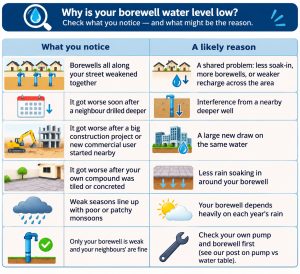
The last row matters: not every weak borewell is a groundwater problem. If your neighbours are fine and you aren’t, it could be a worn pump or a silted borewell.
So is saving water pointless?
No, and please don’t stop. It reduces how long your pump runs, which saves electricity and wear on the motor, and it cuts what you take from the shared account.
But it only works on one side of the account. It can’t refill the ground, stop a neighbour’s deeper borewell, or unseal a paved road. You can spend less every month, but if the money coming in keeps shrinking, the balance still falls. Careful spending slows the decline. It doesn’t reverse it.
The part you actually control: your deposits
There’s one side of the account you don’t have to leave to chance. You don’t control the whole neighbourhood, but you do control your own roof and compound, and together they catch a surprising amount of rain.
Earlier posts showed how to work out your number: a 1,500 sq ft roof in a city with 1,000 mm of rain gets about 1.4 lakh litres a year, of which roughly 1.1 lakh litres can realistically be guided back. That’s more than half a year of a family’s water use, and most of it leaves through the drain.
Here are three practical things you can do:
- Send your roof’s rain back towards your borewell. This is the main one. Filter the roof water and guide it down towards the borewell, so the ground around it gets topped up every monsoon. A NeeRain filter does exactly this: it connects to your existing downpipe, catches leaves, dust and grit as the water passes through, and sends the clean water down. It needs no electricity, has no moving parts, and doesn’t require digging up your compound, so a local plumber can usually fit it in a short visit.
- Give your compound a chance to soak. If you’re about to tile or concrete the whole compound, consider leaving open strips, planting beds, a patch of gravel, or paving with gaps between the blocks. One caution: send ground-level runoff to open soil, like a garden bed, not down the borewell. Water from the ground picks up oil, dirt and rubbish you don’t want near your drinking source. Clean, filtered roof water is the right input for the borewell.
- Start tracking, and talk to your neighbours. Use the recovery test from our earlier posts: let the borewell rest for a few hours, time how long it takes to give a full flow, and write it down before and after each monsoon. If your neighbours do it too, you’ll see whether it’s a street-wide pattern or just yours. And if several households on a lane start recharging, the whole area benefits, because groundwater is shared.
What recharge can and can’t do
An honest note, as in every post on this blog: recharge from one roof won’t fix a neighbourhood’s deficit in a single monsoon. An account overdrawn for years takes seasons of deposits to turn around. Some of the water you send down will also reach your neighbours’ borewells, which is good for the area, but means your results depend on your local ground and on how many others join in.
What recharge does is change the direction. Instead of each monsoon passing without refilling the ground, each one adds something back. Over several seasons, that tends to show up as a borewell that recovers faster and holds its flow longer into summer. Fresh rain can also dilute the mineral-heavy water around the borewell, as we covered in our post on hard water.
Questions people often ask
Is my neighbour to blame for my borewell drying up? Not necessarily. A deeper nearby borewell can lower the level around you, but it’s usually the combined effect of sealed ground, more borewells, fewer ponds and uneven rain.
Should I get a deeper borewell instead? Drilling deeper chases a falling water table, can worsen things for everyone nearby, and is the most expensive response. We’ll cover that in a separate post.
A short checklist
- Notice what has changed around you in recent years: paving, new buildings, new borewells, lost ponds.
- Ask a few neighbours whether their borewells have weakened too.
- Time your borewell’s recovery now, and write the number down.
- Send filtered roof water towards your borewell before the next monsoon.
- Leave some open ground in your compound where rain can soak in.
- Test again after the monsoon, and compare.
The bottom line
If your borewell is weakening even though you use less water than you used to, you’re probably not doing anything wrong. The ground around you has been sealed, the number of straws in the same glass has grown, and the old ponds and open spaces that refilled it have shrunk.
You can’t undo all of that. But you can control one thing; how much of the rain that falls on your roof ends up back in the ground beneath you. Saving water slows your withdrawals. Recharge rebuilds your deposits. A borewell needs both.