
Somewhere above your house right now, a cloud is carrying water that evaporated from the ocean weeks ago, drifted hundreds of kilometres on the wind, cooled, condensed, and gathered into the grey mass sitting over your city today. In a few minutes, one drop out of that enormous mass is going to fall on exactly one square metre of your roof. It has no idea that’s about to happen. It’s just rain, doing what rain has done for longer than houses have existed.
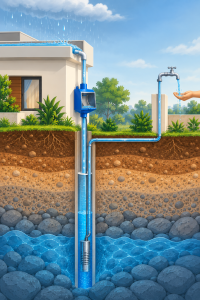
But what happens to that drop in the next few minutes and the next few months depends entirely on something your house either has or doesn’t have. Let’s follow it all the way from the cloud to your tap, and see exactly where the choices get made.
The fall
The drop leaves the cloud and falls for several seconds, picking up a trace of dust from the air on the way down, but otherwise arriving about as clean as water gets anywhere in nature. It hasn’t touched soil. It hasn’t passed through a single pipe. It hasn’t sat in a tank absorbing whatever a tank absorbs over time. For this one brief moment, it is purer than almost any other water your house will see all year.
It lands on your roof and joins a thin, fast-moving sheet of water already spreading across the surface thousands of drops just like it, all moving the same way, pulled downhill by gravity toward the lowest edge of the roof and the open mouth of your downpipe. If you’ve ever stood under an awning during a heavy shower and watched that sheet rushing past, you’ve watched exactly this moment happen, probably without thinking about where any of it was actually going.
The first choice
Here’s where the story splits, and this is the part almost no household ever stops to consider. For the overwhelming majority of roofs in India, this moment is the end of the journey that actually matters. The water reaches the downpipe, drops straight down, hits the ground, and runs along the compound into a drain. From there it joins the stormwater system, leaves the property, leaves the street, and often leaves the neighbourhood entirely. It might eventually reach a river. It might sit in a drain somewhere far away, doing nothing useful for anyone. Either way, it has nothing more to do with the borewell your own house depends on every single day.
That’s not a failure of the rain. The rain did exactly what rain does it fell, and it followed gravity. It’s a failure of the pipe it fell into having nowhere better to send it.
In a house set up for recharge, though, the drop’s journey is only just getting started.
The filter
Instead of running straight to the drain, the drop is intercepted along with the rest of the roof’s runoff and guided through a filtration unit mounted on the downpipe. This is the point where a NeeRain filter does its work. As the water passes through, leaves, dust, and the fine grit that accumulated on the roof since the last rain get caught and separated out, while the cleaned water continues on its way down, pipe to pipe, toward the ground.
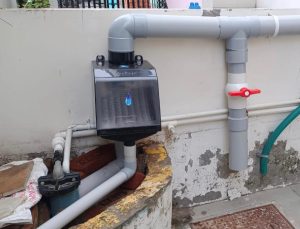
This step matters far more than it looks like it should. Unfiltered runoff carries exactly the kind of debris that clogs pipes, silts up the soil around a recharge point, and over time can even work its way into the borewell it’s supposed to be helping. The drop that emerges from the filter isn’t just rainwater anymore. It’s rainwater that’s genuinely safe to send underground, instead of a mix of water and roof grime that could do more harm than good.
The dirtiest drops never make it
Not every drop that reaches the filter is treated the same way, and that’s deliberate. The very first rain of each shower sometimes the first rain of the whole monsoon, after a long dry summer carries far more dust and grime than anything that falls after it, simply because it’s washing months of accumulated roof grit away in one go. A well-designed system quietly diverts this dirtiest portion away before it ever reaches the filter properly, the same instinct as rinsing a glass before you actually fill it.
Our drop might be one of the lucky ones that falls twenty minutes into a downpour, well after that first dirty rush has already been sent elsewhere. Or it might be one of the first drops of the season, quietly rejected and sent straight to the drain, never getting the chance to start the longer journey at all. Either way, this small, almost invisible sorting decision is happening constantly, every single time it rains, long before anyone outside is even thinking about where the water is going.
The disappearance
From the filter, the drop travels down a final stretch of pipe and arrives at the point where it’s released into the soil, close to your borewell. And here, for a while, it simply disappears from view.
This is the part of the journey nobody ever gets to watch, which might be exactly why it’s the part people trust the least. The drop moves downward through layers of soil and rock, pulled by gravity, spreading sideways a little as it travels, gradually becoming part of a much larger, almost entirely invisible body of water sitting underground. That underground water, often called an aquifer, is the same water table your borewell has been quietly drawing from for years a layer of soaked, saturated earth rather than a cave or an underground lake, holding water the way a sponge holds water rather than the way a bottle does.
It doesn’t happen instantly. Depending on the type of soil, it can take anywhere from a few days to several weeks for a drop to properly settle into that layer. But it does happen, and it’s the exact same basic process that has been filling underground water supplies since long before anyone ever dug a well or installed a pump. The only thing that’s changed is that this particular drop was given a cleaner, more direct path than it would have found wandering through open, uneven ground on its own.
The wait
This is the longest part of the story, and also the quietest. The drop joins thousands of others just like it, sitting in the ground, in absolutely no hurry. It might get pulled up through your borewell next week. It might still be sitting there next summer. It might even end up drawn toward a neighbour’s borewell instead of yours, since groundwater doesn’t recognise property boundaries the way compound walls and fences do it simply moves toward wherever it’s being drawn from hardest.
This is also exactly what makes recharge a long game rather than an instant fix. One monsoon’s worth of drops won’t undo years of decline by itself, any more than a single deposit clears a long-overdue overdraft. But every monsoon that sends water down this path instead of out to a drain adds a little more to what’s waiting underground, and over several seasons, that steady accumulation is precisely what turns a struggling borewell back into a reliable one.
A tale of two roofs
Picture two houses on the same street, built the same year, drawing from borewells that tap into the same underground layer of water. One has a downpipe that simply ends at the ground, the way most houses do. The other has a filter fitted to its downpipe, quietly sending cleaned rainwater down near its borewell every time it rains.
For the first year or two, you’d barely notice a difference between them. Then a dry summer arrives, a little harsher than the ones before it. In the first house, the pump runs longer, the pressure thins out earlier in the season, and the family starts eyeing the calendar nervously each April. In the second house, the borewell still dips a little groundwater is shared, after all, and no single roof controls the whole street’s water table but it recovers faster, holds its flow a little longer, and the dry season feels less like an emergency and more like business as usual.
Neither family did anything dramatic. One of them just gave a few thousand drops, every monsoon, a better place to go than the drain.
It was never really about one drop
Zoom out from our single drop for a moment, and the real scale of this starts to show. One roof doesn’t produce one drop in a monsoon it produces millions of them, falling over months, each one facing the same fork between drain and filter. A modest house can realistically send well over a lakh litres down that second path in a single year, as earlier posts on this blog have worked out in detail.
Now zoom out further. That same choice is being made, or not made, on every roof on your street, above the same shared layer of underground water that all of your borewells draw from. A single house doing this is a quiet, private improvement. A whole street doing it, roof after roof, is the difference between a neighbourhood’s water table slowly recovering and one that keeps sliding in the same direction it always has. Our one drop was never really the point it was just the easiest way to see, up close, a decision that only matters once it’s repeated millions of times over, on roof after roof, monsoon after monsoon.
The return
Eventually, your pump switches on. Somewhere in the underground water your borewell draws from, our drop or more realistically, a vast number of others just like it gets pulled upward through the casing pipe, pushed through your household plumbing, and arrives, finally, at your tap, your shower, or the bucket you’re filling for the evening.
It’s worth pausing on just how long that journey actually was. Cloud to roof. Roof to filter. Filter to soil. Soil to aquifer. Aquifer to pump. Pump to tap. Most households only ever witness the very first step and the very last one rain falling outside the window, and water coming out of a tap indoors with no idea that everything in between either happened quietly and well, or never happened at all, depending on one connection that was or wasn’t made.
What decides the whole story
The entire difference between the two versions of this journey drop to drain, or drop to tap, months later, exactly when it’s needed comes down to one decision, made once, at the single point where a downpipe either ends at a drain or continues on through a filter and down into the ground. Nothing about the rain changes between the two outcomes. Nothing about the borewell changes either. The only thing that changes is whether that one connection exists.
This is really the entire idea behind borewell recharge, told as a story instead of a statistic: it isn’t a complicated intervention, and it isn’t asking the rain to do anything it wasn’t already willing to do. It’s simply giving it a better path to follow one that ends, eventually, back in your own borewell, instead of disappearing down a drain and out of your life for good.
The bottom line
Every monsoon, your roof plays host to millions of drops exactly like the one we just followed. Most of them, in most houses, take the short and forgettable route roof to drain, and gone for good. A much smaller number, in the houses that bothered to make one simple connection, take the longer, quieter route roof to filter to ground to borewell to tap and come back, months later, to be useful at exactly the moment it matters most.
The rain isn’t the variable in this story. You are.