
Think back to the last time your borewell struggled.
Maybe it was April. The motor was running longer than usual before any water came up. The tank on the terrace was only half full by evening. You made a call, booked a tanker, waited, and eventually the water arrived. A few days later the pressure improved a little, and life went back to normal. You paid the tanker, paid the electricity bill, and moved on.
Most of us remember a dry summer as an inconvenience. Very few of us ever add it up. And when you do add it up, the real cost is usually bigger than the single tanker bill you remember, and it tends to repeat every year.
This post is a plain, honest walk through what a dry summer actually costs a household that depends on a borewell. It uses real price ranges where they exist, includes a worked example, and ends with a simple worksheet so you can find your own number.
First, an honest note about prices
Costs vary a lot from city to city, and even from street to street. A tanker that costs one amount in Bengaluru can cost very different amounts elsewhere, and prices usually rise when summer gets harsh and everyone is booking at once. So treat the figures below as examples to give you a sense of scale, not as quotes. The worksheet near the end lets you replace them with your own bills.

Cost 1: The tanker
This is the one everybody remembers, so let’s start here.
As an example, a Bengaluru news report from March 2025 put the price of a 6,000-litre tanker at roughly ₹600 to ₹650, and a 12,000-litre tanker at around ₹1,400. Those are the rates the residents were quoted at the start of that summer.
Now let’s see what that means for a family. Earlier posts on this blog used the common planning figure of about 135 litres per person per day. For a family of four, that’s around 540 litres a day. If your borewell can’t meet the family’s needs for 90 days of a bad summer, that’s about 48,600 litres, or roughly four 12,000-litre tankers. At the Bengaluru rate above, that comes to about ₹5,500 to ₹6,000.
That’s an honest number, and it isn’t dramatic. If tankers were the only cost, many households would shrug and pay it. The trouble is that tankers are almost never the only cost. They’re the first line of a longer invoice.
Cost 2: Your pump, working overtime
When water levels drop, a borewell pump has to work harder. It runs longer to fill the same tank, it may run when there’s less water around it, and it ends up on and off more often as the water recovers slowly between draws.
None of that is good for a pump. A pump that has been strained for several summers is more likely to burn out, wear down, or need repairs. According to a borewell cost guide published by JK Cement, a submersible pump alone can cost between ₹18,000 and ₹70,000, depending on its size and type. That is before the electrical panel and wiring, which the same guide puts at ₹15,000 to ₹40,000.
Not every dry summer ends with a new pump, of course. But the risk goes up each year the water level keeps falling, and when a pump does fail, the bill arrives suddenly and in one piece.
Cost 3: The electricity bill nobody connects to the borewell
This one is easy to miss, because it hides inside a monthly bill that has many other things in it.
A pump that runs longer to deliver the same water uses more electricity. It’s a small amount each day, but it’s repeated every day of a long summer. You won’t see a line on your electricity bill that says “borewell struggling,” which is why most people never connect the two.
Cost 4: Going deeper, or going again
This is the big one, and it’s what happens when a borewell finally gives up or stops being worth patching.
The usual response is to deepen it or drill a new one. The same JK Cement guide puts the overall cost of a residential borewell, at 300 to 600 feet and including equipment, at roughly ₹1.5 lakh to ₹5 lakh. Drilling alone is quoted at about ₹120 to ₹350 per foot depending on whether the ground is soil or hard rock. Those are indicative figures, and your local price may differ.
Here’s the part that deserves a pause. Drilling deeper doesn’t fix the cause. A deeper borewell chases a falling water table, which means it may only buy a few more years before the same problem returns. It’s a bit like moving your bucket further down the well instead of asking why the water is dropping.
Cost 5: Everything else that quietly adds up
There’s a layer of smaller costs that rarely get counted:
- Buying drinking or cooking water when the borewell water is low or muddy.
- Extra storage, such as larger tanks or drums, bought to cope with irregular supply.
- Plumber visits for pressure problems that keep coming back.
- Cleaning and repairs when a low borewell pulls up more silt than usual.
Individually, these are small. Over a few summers, they stop being small.
Cost 6: The cost you can’t put a price on
Then there is time and stress. Waiting at home for a tanker to arrive. Rationing water within the family. Calling the same supplier again and again. Planning the week around when the water is available. None of this shows up on a receipt, but anyone who has lived through a bad summer knows it’s the part that wears you down.
Putting it together: three kinds of dry summer
Using only the ranges above, here’s how the cost can climb depending on how bad the summer gets. These are illustrative, and your own figures will differ.
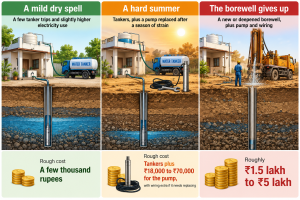
Notice that the first row is something most families can absorb without much thought. The second and third rows are where the real money is, and they don’t arrive with a warning. They arrive after several summers of the water table slowly dropping, when the borewell finally can’t cope.
A household over five summers (an illustration)
Numbers in a table are easy to skim past, so let’s follow one imaginary household across five dry summers. This is an illustration built from the example ranges above, not a prediction, and not every borewell follows this path. Some recover, some fail sooner. But it shows how the costs stack.
Summer 1: a mild dry spell. The pump runs a little longer and the tank is slow to fill by April. The family books about four tankers over the season. Cost: roughly ₹5,500 to ₹6,000, at the example Bengaluru rates.
Summer 2: a little harder. The slow-filling starts a few weeks earlier than last year, and the dry stretch lasts around four months. That’s about 65,000 litres of extra water needed, or five to six tankers. Cost: roughly ₹7,000 to ₹8,500.
Summer 3: the pump gives up. After two seasons of working harder than it was built to, the pump burns out in May. The family pays for tankers again, and for a replacement pump. Cost: tankers of about ₹8,000 to ₹10,000, plus ₹18,000 to ₹70,000 for the pump.
Summer 4: stable, but fragile. The new pump works well, but the water table keeps dropping underneath it. Tankers are needed earlier and for longer. Cost: roughly ₹10,000 to ₹12,000.
Summer 5: the borewell fails. Pressure collapses in March, and a technician says it’s no longer worth repairing. The family drills a new borewell or deepens the old one. Cost: roughly ₹1.5 lakh to ₹5 lakh.
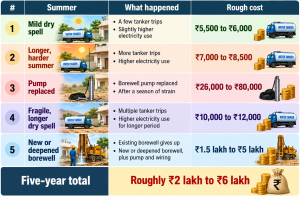
Look at where the money actually went. In years one, two and four, the family paid a few thousand rupees and barely noticed. Nearly all the cost landed in years three and five, in two sudden, large bills. That’s why a dry summer is so easy to underestimate. The small bills look harmless, and the big ones arrive without much warning.
Why it keeps repeating
Here’s the pattern worth noticing. A dry summer isn’t a one-time event for most borewells. It’s a symptom of a water table that’s falling year after year, which means the next summer is usually a little harder than this one, not easier.
So the real cost isn’t one bad summer. It’s the same set of costs, repeated and gradually growing, until the day the borewell stops being usable at all.
Your own number: a quick worksheet
You don’t need exact figures for this. Rough numbers from memory are enough. Write down:
- Tanker trips last summer × the price you paid per trip.
- Pump repairs or replacement in the last three years, with the amounts.
- Extra electricity in summer months compared with the rainy months. A rough guess is fine.
- Plumber or repair visits related to water pressure.
- Drinking or cooking water bought separately.
- Any deepening or redrilling you’ve done in the past, however long ago.
Add the six lines. Then multiply the yearly part by the number of years you expect to live in the house. That’s the real price of doing nothing, and it’s a number most people have never seen written down.
“But tankers are cheap, so why bother?”
It’s a fair objection, and the numbers above show why people make it. If a mild summer costs a few thousand rupees in tankers, it can feel silly to spend anything to avoid it.
Here is an honest answer in three parts.
First, you’re right about the mild years. If your borewell will stay healthy enough that only a few tankers a year are ever needed, tanker costs on their own are not a strong reason to do anything.
Second, the problem isn’t the tanker. It’s the cliff behind it. The tanker is the comfortable part of the story. The pump replacement and the new borewell are where the real money is, and a falling water table is what leads there. Recharge isn’t aimed at the tanker bill. It’s aimed at the water table that eventually forces the bigger bills.
Third, tankers carry costs that aren’t on the receipt. You wait for them. You depend on a supplier showing up on a day when everyone else is also calling. And you often can’t tell where the water came from, so it may be fine for washing and not what you want for cooking. A borewell that holds up is simply more convenient, and more predictable, than a phone call.
Where recharge changes the picture
Recharge works on the cause, not on the symptoms. Instead of paying for tankers, pumps and deeper drilling every time the water table drops, you put water back into the ground near your borewell every monsoon, so the level your borewell depends on has a chance to hold up or recover.

A NeeRain setup does this by connecting to the downpipe you already have, filtering the rain as it passes through, and guiding the clean water down towards your borewell. It needs no electricity, has no moving parts, and doesn’t need the compound dug up. It’s a one-time cost, ask the NeeRain team for a quote for your roof, and you can then compare it with the worksheet number above. For many households, that comparison is the moment the decision gets easier.
An honest caveat belongs here, as it does in every post on this blog. Recharge is not a guarantee. Groundwater is shared across a neighbourhood, results depend on local ground conditions, and a single monsoon rarely undoes years of decline. What recharge does is add to the underground water every year, and over several seasons that tends to show up as a borewell that recovers faster and holds out longer into summer. Measuring your borewell’s recovery time before and after the monsoon is the simplest way to see whether it’s working for you.
Questions readers often ask
Will recharge end my tanker bills completely? Honestly, it can’t promise that. Groundwater is shared across a neighbourhood, and results depend on local ground conditions. What recharge aims to do is reduce how often you need tankers over time, and, more importantly, reduce the chance of reaching the expensive end of the table.
How soon will I see a difference? Usually not in a single monsoon. Water takes time to soak down and spread through the ground, and years of decline don’t reverse in one season. Think in seasons, and measure your borewell’s recovery time before and after each monsoon so you can see your own progress.
What if my borewell is already very weak? Recharge works best when there’s still a working borewell to top up. If yours is still giving water, even weakly, that’s the right time to start, since waiting only lets the water table fall further. If it has already failed completely, it’s worth getting it checked by a borewell technician before deciding anything.
Is it worth it if I might move in a few years? The setup stays with the property, and a house with a borewell that holds up through summer is easier to live in, and to sell or rent out, than one with a borewell that struggles. It’s worth weighing against how long you expect to stay, and your worksheet number will help.
Do I have to do anything every year? Yes, a little. A filter needs a quick clean before and after each monsoon, which takes a few minutes. It’s far less effort than managing tankers.
The bottom line
A dry summer doesn’t cost one tanker bill. It costs a tanker bill, a strained pump, a larger electricity bill, a pile of small extras, and sometimes a new borewell, repeated year after year while the water table keeps dropping.
Write your own number down this week. Seeing the total on paper is often the moment people stop treating a dry summer as bad luck and start treating it as a problem with a fix. And the best time to start is before the next monsoon, so that the first big rain goes back into your borewell instead of down the drain.